
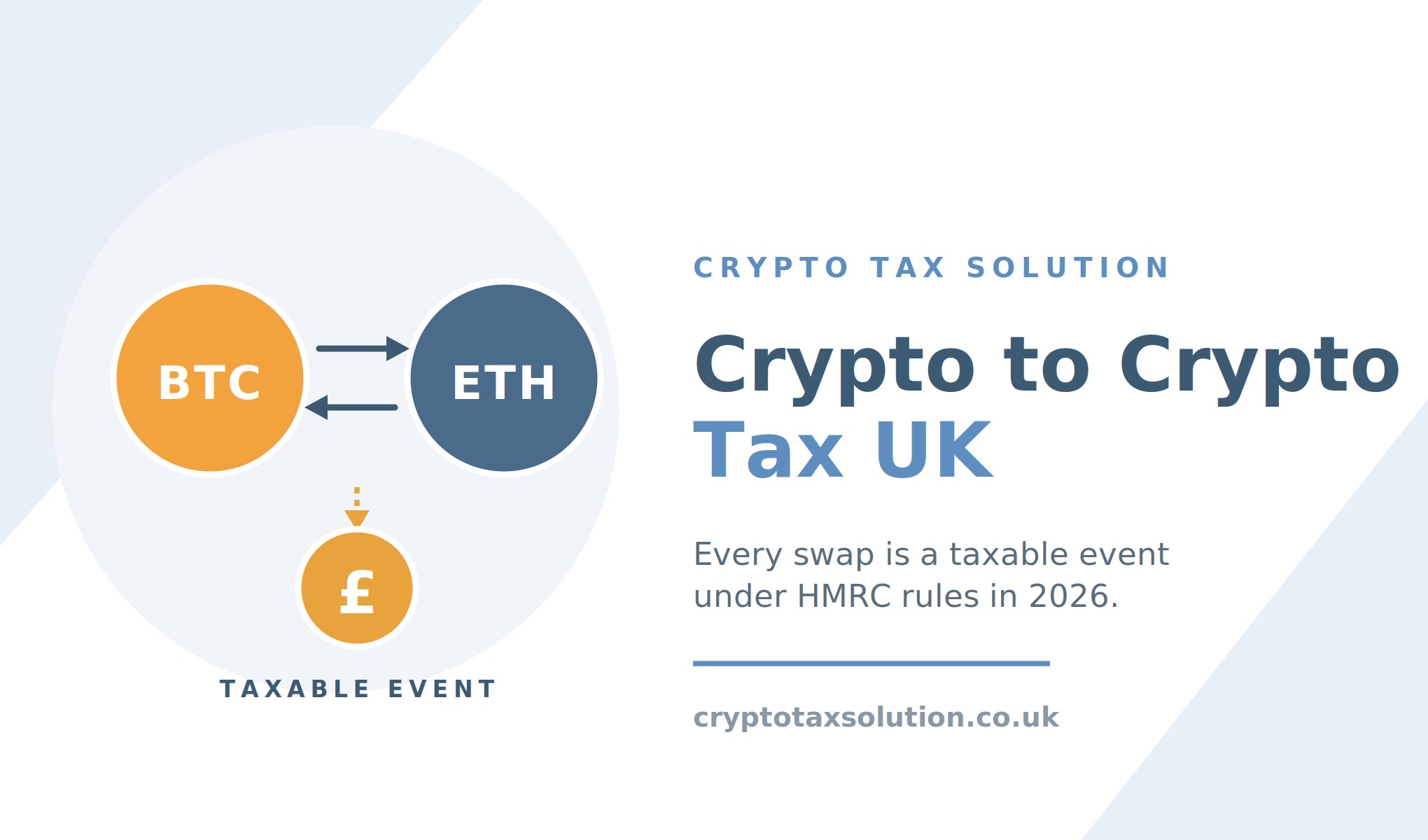
 Crypto to crypto tax UK rules catch out more investors than any other corner of HMRC’s crypto guidance. The mistake is almost always the same: people assume that as long as they have not cashed out into pounds, no tax can possibly apply. That assumption is wrong, and in 2026 it is becoming an expensive one.
Every time you swap one cryptocurrency for another, HMRC treats it as a disposal of the first coin. That triggers Capital Gains Tax, even if you never see a single pound hit your bank account. With CARF now live and UK exchanges feeding transaction data straight to HMRC from January 2026, the days of these swaps slipping under the radar are over.
This guide explains exactly how crypto to crypto tax UK works, how the gain is calculated, the rates that apply in 2026/27, and what you need to do to stay on the right side of HMRC.
What is crypto to crypto tax UK?
Crypto to crypto tax UK is the Capital Gains Tax that applies whenever you swap one cryptocurrency for another. The simplest example: you sell Bitcoin to buy Ethereum. HMRC treats that as two events combined into one. You have disposed of your Bitcoin and acquired Ethereum, and the disposal of the Bitcoin can produce a taxable gain.
This applies to every kind of swap:
- Trading Bitcoin for Ethereum on a centralised exchange.
- Swapping ETH for SOL through Uniswap or another decentralised exchange.
- Converting one stablecoin to another (USDT to USDC, for example).
- Wrapping or unwrapping a token (such as BTC to wBTC).
- Using one token to buy an NFT.
In every one of these scenarios, crypto to crypto tax UK rules apply because HMRC considers each crypto asset as separate property. Swapping one for another means you have disposed of the first.
Why HMRC treats every swap as a disposal
HMRC’s position has been consistent since its first cryptoassets manual was published in 2019. Crypto is property, not currency. That single classification is why crypto to crypto tax UK works the way it does.
When you swap one crypto for another, you are effectively selling one piece of property and buying another. In HMRC’s view, the fact that no fiat money changed hands is irrelevant. The gain is calculated by comparing the pound sterling value of the crypto you disposed of, at the moment of the swap, with what it originally cost you.
This is the same principle that applies if you sold a share in one company to buy a share in another. The exchange of one asset for another still triggers a disposal. The crypto to crypto tax UK position simply applies that long-established principle to digital assets.
How crypto to crypto tax UK is calculated
Working out the gain on a crypto to crypto swap involves three steps.
1. Identify the disposal value. This is the pound sterling market value of the crypto you swapped away, at the moment the swap happened. For a Bitcoin to Ethereum swap, that means the GBP value of the Bitcoin at the time of the trade, not at the time you bought it.
2. Identify the cost basis. This is what the crypto you disposed of originally cost you, including any transaction or gas fees. If you have bought the same crypto more than once at different prices, HMRC’s share pooling rules apply.
3. Apply the share pooling rules. Crypto to crypto tax UK calculations follow the same matching rules as shares:
- Same-day rule: If you bought the same coin earlier on the same day as the disposal, that purchase is matched first.
- 30-day rule: If you bought the same coin in the 30 days after the disposal, that purchase is matched next. This is the “bed and breakfasting” rule that stops investors from selling and immediately rebuying to crystallise an artificial loss.
- Section 104 pool: Everything else is averaged into a single pool with one weighted-average cost basis.
Getting the share pooling right is the part of crypto to crypto tax UK that trips up the most investors, especially anyone trading actively across multiple wallets and exchanges. Our guide to crypto tax records UK investors should keep sets out exactly what you need.
Worked example: an ETH to SOL swap
Let’s bring crypto to crypto tax UK to life with a worked example.
You bought 5 ETH in 2024 at an average price of £2,000 per ETH, so your cost basis in the section 104 pool is £10,000. In June 2026, you swap 2 ETH for SOL when the ETH price is £3,200.
- Disposal value: 2 ETH x £3,200 = £6,400.
- Cost basis used: 2 ETH out of 5 in the pool, so 2/5 of £10,000 = £4,000.
- Taxable gain: £6,400 – £4,000 = £2,400.
That £2,400 gain is reportable, even though you received no fiat money. The SOL you received then sits in its own section 104 pool with a cost basis of £6,400, ready to be tracked for the next disposal. This is exactly how crypto to crypto tax UK rules work in practice.
What crypto to crypto tax UK rates apply in 2026/27?
The Capital Gains Tax rates that apply to crypto to crypto tax UK gains in the current 2026/27 tax year are:
- Annual exempt amount: £3,000. Gains up to this threshold across all your capital disposals (crypto, shares, and other assets) are tax-free.
- Basic rate (18%): Applied to gains that fall within your remaining basic rate band after income.
- Higher rate (24%): Applied to gains above the basic rate threshold.
So a higher rate taxpayer with the £2,400 gain in the worked example above would owe nothing if it is their only capital gain in the year, because it sits within the £3,000 annual exempt amount. But pile up several swaps across the year and the threshold disappears fast.
It is also worth remembering that crypto to crypto tax UK gains stack with every other capital gain you make. Sell a buy-to-let, dispose of some shares, and swap some crypto in the same year, and the single £3,000 allowance covers the lot.
Stablecoins, wrapped tokens, and other edge cases
One of the most common misconceptions is that swapping into a stablecoin somehow does not count. It does. As far as crypto to crypto tax UK rules are concerned, USDT is just as much a crypto asset as Bitcoin. Swapping ETH for USDT is a disposal of ETH and an acquisition of USDT. The gain on the ETH is taxable.
Wrapped tokens follow the same logic. When you wrap BTC into wBTC, you have technically disposed of BTC and received a different asset. HMRC’s published guidance suggests this is a disposal, although there is ongoing consultation and the position may soften in future. For now, the safe assumption under crypto to crypto tax UK rules is that any change of token is a disposal.
Bridging tokens between blockchains is the same story. Moving an ERC-20 to a different chain through a bridge is usually treated as a disposal and re-acquisition. You can read more in our guide to crypto bridging tax UK.
How CARF makes crypto to crypto tax UK unavoidable
From 1 January 2026, the Crypto-Asset Reporting Framework requires UK exchanges and platforms to send transaction data directly to HMRC. That includes every swap you make, every disposal, and every acquisition. Our full CARF guide explains the detail.
What this means for crypto to crypto tax UK compliance is simple. HMRC will know about your swaps. Investors who have spent years assuming that crypto to crypto swaps fly under the radar are about to discover that those days are over. Voluntary disclosure now, before HMRC starts comparing CARF data to filed returns, will almost always lead to a softer landing than waiting for an HMRC crypto nudge letter to arrive.
How to report crypto to crypto swaps to HMRC
If your total taxable crypto gains exceed the £3,000 annual exempt amount, or your total disposal proceeds exceed £50,000 in the tax year, you must report your crypto to crypto tax UK position through Self Assessment.
The reporting process looks like this:
- Calculate the gain on every disposal in the tax year, including every crypto to crypto swap, using HMRC’s share pooling rules.
- Add up your total gains and subtract any allowable losses.
- Apply the £3,000 annual exempt amount.
- Report the remaining taxable gain on the Capital Gains pages of your Self Assessment return.
- Pay any CGT due by 31 January following the end of the tax year.
This is more straightforward in theory than in practice. The volume of swaps an active investor can rack up across centralised exchanges, decentralised exchanges and wallets can run into the thousands. Getting crypto to crypto tax UK calculations right almost always means using specialist software or working with a crypto tax accountant.
Frequently Asked Questions
Do I really pay tax on a crypto to crypto swap?
Yes. Crypto to crypto tax UK rules treat every swap as a disposal of the first crypto and an acquisition of the second. HMRC has been clear on this since 2019 and the rules have not changed in 2026.
What if I only swap between stablecoins?
Stablecoin to stablecoin swaps still count as disposals under crypto to crypto tax UK rules. The gains may often be small, but they still need to be tracked because they affect your pooled cost basis on later trades.
How much can I gain before paying crypto tax?
In 2026/27 the annual exempt amount is £3,000. Crypto to crypto tax UK gains up to that threshold are not taxable, but they may still need to be reported if total disposal proceeds exceed £50,000 in the tax year.
Can I offset crypto losses against crypto to crypto gains?
Yes. Allowable capital losses, including losses on crypto disposals, can be offset against gains in the same year. Unused losses can be carried forward to future years if they are reported to HMRC within four years of the tax year in which the loss occurred.
What happens if I never reported my past crypto swaps?
HMRC has a voluntary disclosure route specifically for crypto. Coming forward before HMRC contacts you usually results in significantly reduced penalties. With CARF data now flowing to HMRC, voluntary disclosure is the fastest way to settle past crypto to crypto tax UK exposure on the best possible terms.
Crypto to crypto tax UK: get expert help
Crypto to crypto tax UK rules are not difficult in theory, but they become very hard to apply correctly once you have hundreds of swaps across multiple platforms. Get it wrong and you risk penalties. Get it right and you stay compliant with minimum fuss.
At Crypto Tax Solution, we help UK investors reconstruct their full trading history, calculate every crypto to crypto tax UK gain correctly, and file accurate returns with HMRC. Get in touch today and we will take the calculation off your plate so you can get back to investing with peace of mind.