
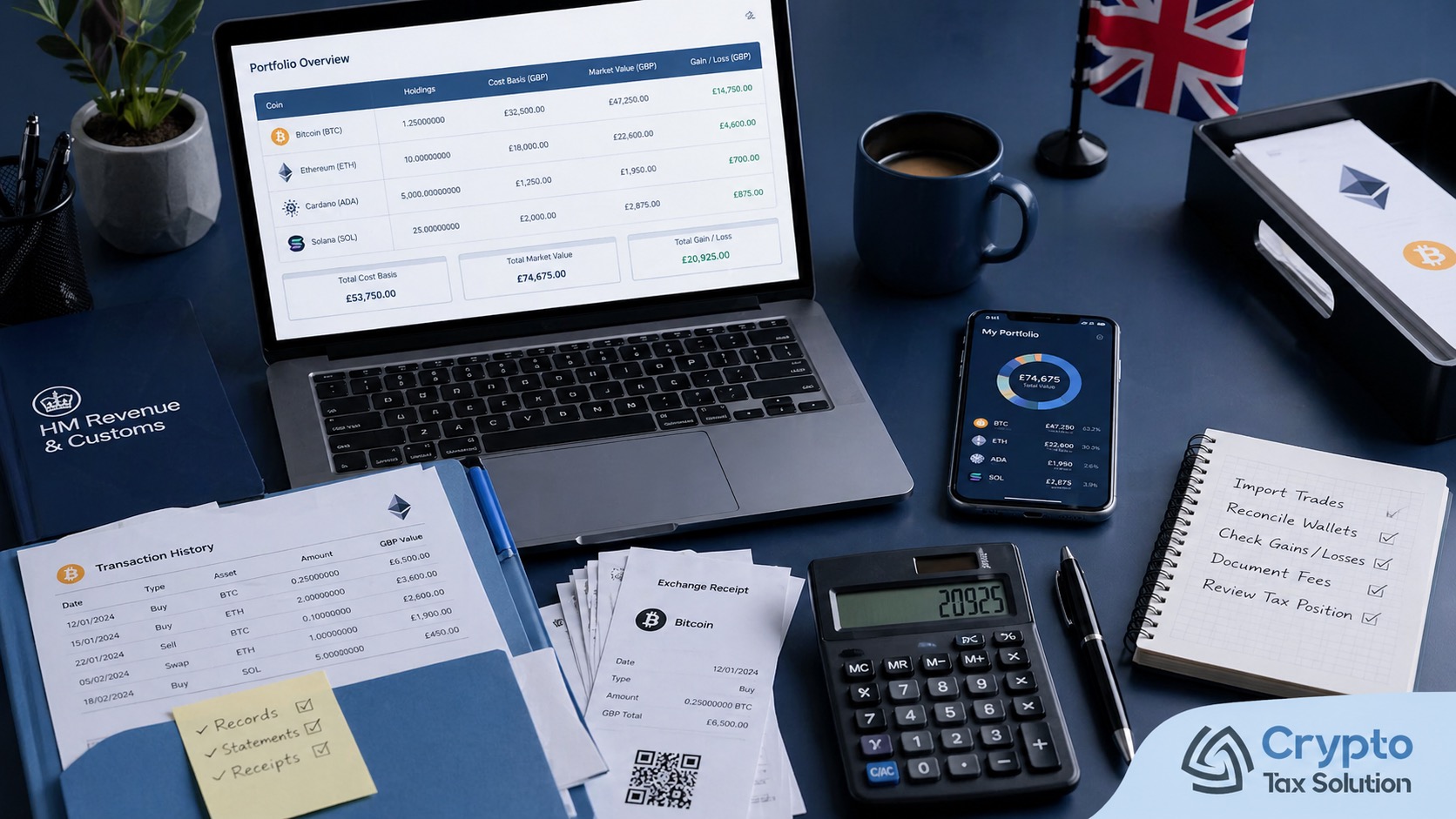
 Crypto tax records UK investors keep are becoming more important than ever. It is no longer enough to know roughly how much you bought, sold or withdrew. HMRC expects crypto investors to keep proper records, calculate gains correctly and report taxable activity through Self Assessment where required.
This matters because crypto tax is not always obvious at the point of transaction. Selling Bitcoin for pounds can create a taxable disposal, but so can swapping one token for another, spending crypto, gifting crypto to someone other than a spouse or civil partner, or taking part in certain DeFi activities.
With HMRC’s <a href=”https://www.gov.uk/government/collections/reporting-to-hmrc-if-you-provide-cryptoasset-services-in-the-uk” target=”_blank” rel=”noopener”>Cryptoasset Reporting Framework</a> increasing the amount of information that crypto service providers collect and report, poor records are becoming a much bigger risk. HMRC guidance confirms that cryptoasset service providers must collect user and transaction data under CARF, with the first reporting period covering activity from 1 January 2026 to 31 December 2026.
If your exchange data, wallet activity and tax return do not line up, HMRC may ask questions. Good crypto tax records UK investors can rely on are therefore not just useful. They are your defence.
Why crypto tax records UK investors keep are so important
For many investors, the biggest crypto tax problem is not the tax rate itself. It is the record trail.
You might have used several exchanges, transferred coins between wallets, bought tokens on one platform, sold them on another, joined a staking pool, received rewards, swapped tokens through DeFi, or lost access to an old wallet.
Each of those events can affect your tax position.
HMRC’s rules require individuals to keep records of the amount spent on each type of token, as well as the pooled allowable cost for each pool. This is important because the UK does not usually use a simple “first in, first out” method for crypto. HMRC applies matching and pooling rules, including same-day rules, 30-day rules and Section 104 pooling.
That means your crypto tax records UK file needs to show more than just deposits and withdrawals. It needs to help explain how each gain, loss, income item and disposal was calculated.
1. Transaction dates and times
The first thing to keep is the date and time of every crypto transaction.
This includes purchases, sales, swaps, transfers between wallets, staking rewards, mining income, airdrops, NFT sales, crypto payments, gifts, and DeFi deposits or withdrawals.
Dates matter because HMRC’s matching rules can change the result of your gain or loss calculation. A sale followed by a repurchase shortly afterwards may not be treated the way many investors expect.
Good crypto tax records UK investors prepare should therefore include exact timestamps where possible, not just the month or year.
2. The value in pounds sterling
HMRC expects tax to be calculated in pounds sterling. That means you need a reasonable GBP value for each taxable event.
For example, if you swap ETH for SOL, you need to know the GBP value of the ETH disposed of and the GBP value of the SOL acquired at the time of the transaction. If you receive staking rewards, you may need the GBP value of those rewards when received.
This is where many investors get caught out. They may have token quantities but no reliable GBP valuation. Without that, your crypto tax records UK calculation becomes guesswork.
A good record should include the token name, token quantity, GBP value, exchange rate source, transaction fee, date and time.
3. Exchange statements and CSV files
You should download full transaction reports from every exchange you have used.
Do not wait until tax return season. Exchanges can change formats, close accounts, restrict access or remove old reports. Some smaller platforms disappear altogether.
Keep copies of trade history, deposit history, withdrawal history, fee reports, staking reports, earn product reports, account statements and tax reports if available.
These files form the backbone of your crypto tax records UK folder. They also help your accountant reconcile exchange activity with wallet activity.
4. Wallet addresses and transfer notes
Transfers between your own wallets are not usually disposals by themselves, but they still need to be recorded properly.
For example, if you move Bitcoin from Binance to a Ledger wallet, that is generally a transfer rather than a sale. But if your records only show a withdrawal from one place and no matching deposit elsewhere, it may look like a disposal.
Keep a list of wallet addresses you control and label them clearly. This might include your Binance account, Coinbase account, Ledger wallet, MetaMask wallet, Trust Wallet, DeFi wallet or any old phone wallets you have used.
This simple step makes crypto tax records UK preparation much easier. It helps separate genuine taxable disposals from internal movements.
5. Transaction fees
Crypto fees can affect your tax calculation. Depending on the transaction, fees may form part of the cost or reduce the proceeds.
For example, if you sell crypto and pay an exchange fee, that fee may reduce the disposal proceeds. If you acquire crypto and pay a fee, that fee may increase the acquisition cost.
Small fees can add up across hundreds or thousands of transactions. Ignoring them may mean your crypto tax records UK calculation is less accurate than it should be.
Keep records of trading fees, gas fees, withdrawal fees, bridge fees, platform fees and NFT marketplace fees. Even if some fees are tiny, they help complete the picture.
6. Evidence for losses
Crypto losses can be valuable for tax purposes, but only if they are recorded correctly.
If you sell crypto at a loss, that loss may be used to reduce taxable capital gains. However, HMRC will not simply accept a vague statement that “the market went down”. You need records showing the purchase, sale, cost, proceeds and resulting loss.
The UK Capital Gains Tax annual exempt amount is £3,000 for individuals in the 2026 to 2027 tax year, and the same figure applied in 2025 to 2026 and 2024 to 2025. Gains above the available allowance may be taxable depending on your wider position.
You may also find our guide on Lost Crypto Tax UK helpful if your issue involves missing wallets, inaccessible assets or failed platforms.
Good crypto tax records UK investors keep should therefore include loss evidence, not just profitable trades.
This may include exchange statements, sale confirmations, wallet records, screenshots, blockchain explorer links and notes explaining unusual events.
If you have lost access to crypto, been scammed, or had assets become worthless, the position can be more complicated. You may need specialist advice before assuming the loss is claimable.
7. A clear tax-year summary
Your records should not just be a pile of CSV files. You need a tax-year summary that brings everything together.
For each UK tax year, prepare a summary showing total disposal proceeds, total allowable costs, total gains, total losses, net gain or loss, income from staking, mining or rewards, fees included, exchanges and wallets used, and any estimates or assumptions.
This is the document that makes your crypto tax records UK file understandable. It also helps your accountant spot gaps before the Self Assessment deadline.
Common crypto record mistakes
The most common mistake is only recording cash withdrawals to a bank account. Many investors assume they only need to report crypto when they “cash out”. That is not how UK crypto tax normally works.
A crypto-to-crypto swap can still be a taxable disposal. Spending crypto can be a disposal. Gifting crypto can be a disposal. Moving assets through DeFi may also create tax consequences depending on the structure of the transaction.
Another common mistake is relying entirely on tax software without checking the data. Crypto tax software can be useful, but it is only as good as the information imported. Missing wallets, duplicate transfers, incorrect token prices or broken API connections can all distort the final numbers.
The best crypto tax records UK approach is a combination of software, careful review and professional judgement.
How long should you keep crypto tax records?
You should keep your crypto tax records for several years in case HMRC asks for evidence later. The exact period can depend on your circumstances, including whether you file a Self Assessment tax return and whether HMRC opens an enquiry.
A safe approach is to keep all crypto records, calculations and supporting evidence for at least six years. Digital storage makes this easier, and it can save a huge amount of stress later.
Create folders by tax year, for example:
2024-25 crypto tax records
2025-26 crypto tax records
2026-27 crypto tax records
Inside each folder, keep exchange reports, wallet notes, tax software exports, accountant correspondence and your final submitted figures.
Why this matters more from 2026 onwards
From 1 January 2026, UK reporting cryptoasset service providers are required to undertake due diligence on customers and report aggregate transactional data to HMRC annually under CARF. HMRC guidance says the first report will cover the period from 1 January 2026 to 31 December 2026 and must be submitted between 1 January 2027 and 31 May 2027.
This does not create a new crypto tax. It changes the visibility HMRC may have over crypto activity.
In practical terms, investors should assume that crypto tax records UK accuracy is becoming more important. If HMRC receives information from exchanges and your tax return does not reflect your actual activity, it may be harder to explain later.
Need help preparing your crypto tax records?
Crypto tax can become messy quickly, especially if you have used multiple exchanges, wallets, DeFi platforms or staking services.
At Crypto Tax Solution, we help UK crypto investors organise their records, understand their tax position and prepare accurate figures for HMRC.
If you are unsure whether your records are complete, it is better to deal with it before HMRC asks questions.
Need help with your crypto tax records UK calculation? Contact Crypto Tax Solution for specialist support with your UK crypto tax position.
Check out our other posts here.