
 Crypto capital gains tax catches out more UK investors than almost any other area of HMRC’s guidance. The rules are not complicated once you understand them, but the gaps in knowledge are costly. Miss a disposal, misapply the share pooling rules, or ignore the reduced annual allowance, and you face unexpected bills, penalties, and interest.
This guide explains exactly how crypto capital gains tax works in the UK for the 2025/26 tax year, what rates apply, when you are liable, and how to stay compliant without overpaying. At Crypto Tax Solution, we help UK investors calculate and report their gains correctly every year.
What Is Crypto Capital Gains Tax?
Crypto capital gains tax is the tax you pay when you dispose of a cryptoasset for more than you paid for it. HMRC classifies cryptocurrencies including Bitcoin, Ethereum, and most other tokens as property rather than currency. This means every disposal is a chargeable event that may trigger a CGT liability.
The gain is the difference between what you received on disposal and what you originally paid, including any fees. You only pay tax on the profit, not the total proceeds.
When Does Crypto Capital Gains Tax Apply?
Crypto capital gains tax applies whenever you make a disposal. HMRC defines a disposal more broadly than most investors expect. It is not limited to selling crypto for pounds.
The following events all trigger a potential CGT liability:
- Selling cryptocurrency for GBP or any other fiat currency
- Swapping one cryptocurrency for another (for example, Bitcoin for Ethereum)
- Spending crypto on goods or services
- Gifting crypto to someone other than your spouse or civil partner
- Receiving crypto as payment for goods or services at a gain
Each of these is a separate disposal event. If the pound value of what you received exceeds your cost basis, you have a gain. Our FAQ page covers common disposal scenarios in detail.
Crypto Capital Gains Tax Rates for 2025/26
The CGT rates on cryptocurrency changed at the Autumn Budget 2024 and apply to disposals made from 30 October 2024 onwards.
For the 2025/26 tax year:
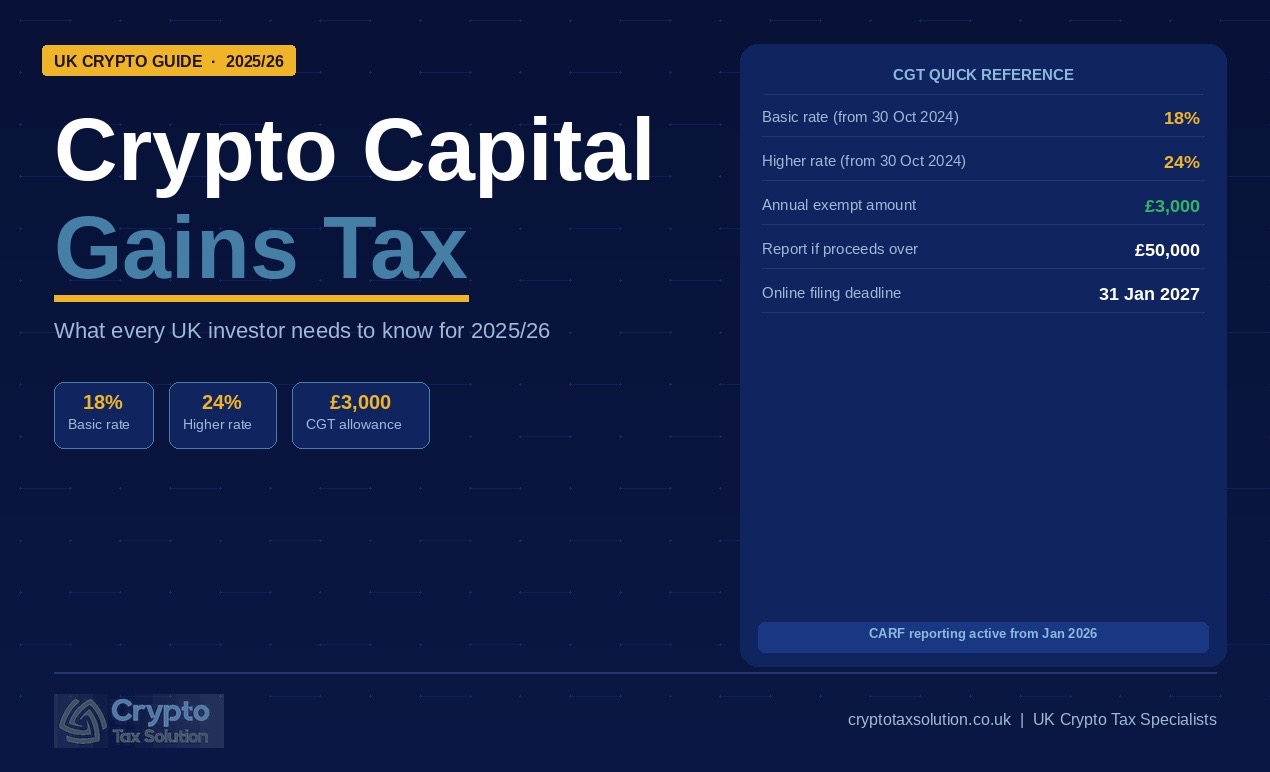
- Basic rate taxpayers: 18% on gains above the annual exempt amount
- Higher rate and additional rate taxpayers: 24% on gains above the annual exempt amount
For disposals made before 30 October 2024 within the same tax year, the previous rates of 10% (basic rate) and 20% (higher rate) apply. Investors who made disposals in both periods of the 2024/25 tax year may need to apply two different rates on the same return.
The rate you pay depends on your total taxable income for the year. If your income plus crypto gains fall within the basic rate band (up to £50,270), you pay 18%. Any gains above that threshold attract the 24% rate.
Crypto Capital Gains Tax Allowance and How to Use It
Every UK individual receives a crypto capital gains tax allowance each year, officially called the annual exempt amount. For 2025/26 this is £3,000.
This means the first £3,000 of gains from all chargeable assets combined, including crypto, shares, and property, is completely free of CGT. You only pay tax on gains above this threshold.
The allowance has fallen sharply in recent years. It was £12,300 in 2022/23, dropped to £6,000 in 2023/24, and has been £3,000 since 2024/25. With a reduced allowance, more investors now have a CGT liability than in previous years, even on modest portfolios.
You cannot carry unused allowance forward to the next tax year. Using it strategically, for example by timing disposals across two tax years, can reduce your overall bill. Our tax calculator helps you model different disposal scenarios before you act.
How to Calculate Your Crypto Capital Gains Tax
To calculate the CGT due on a disposal, you need three figures:
- Disposal proceeds: the pound value of what you received on the date of disposal
- Cost basis: the pound value you paid when you acquired the asset, including fees
- Gain or loss: disposal proceeds minus cost basis
Subtract the £3,000 annual exempt amount from your total net gains for the year. Apply the relevant rate (18% or 24%) to the taxable amount remaining.
Losses from other disposals can be offset against gains in the same tax year. If losses exceed gains, the net loss can be carried forward indefinitely against future gains.
Fees paid on acquisition can be added to the cost basis, and fees paid on disposal can be deducted from the proceeds. HMRC confirms this treatment in their cryptoassets manual on GOV.UK.
Share Pooling Rules and Crypto Capital Gains Tax
One of the most misunderstood areas of crypto capital gains tax is the share pooling rules. HMRC uses the same matching rules for crypto as it does for shares. When you buy and sell the same cryptocurrency multiple times, you cannot simply choose which purchase to match against which sale.
HMRC applies three rules in order:
Same-day rule: If you buy and sell the same cryptocurrency on the same day, those transactions are matched first regardless of price.
30-day rule (bed and breakfasting): If you sell a cryptocurrency and buy the same one within 30 days, the new acquisition is matched against the earlier disposal. This prevents investors from crystallising losses and immediately rebuying.
Section 104 pool: Any remaining acquisitions are pooled together. The cost basis is calculated using the average cost of all pooled tokens.
Applying these rules incorrectly is the most common reason crypto capital gains tax calculations are wrong. See our prices page for the cost of a full calculation review.
How to Reduce Your Crypto Capital Gains Tax Bill
There are several legitimate strategies for reducing your CGT liability.
Use your annual exempt amount. Make sure you use the full £3,000 allowance each year. If you have unrealised gains, consider realising enough to use the allowance before year end.
Offset losses. Register losses with HMRC even if you have no gains to offset this year. They can be carried forward indefinitely.
Spouse or civil partner transfers. Transfers between spouses and civil partners are exempt from CGT, allowing you to use both partners’ allowances and potentially benefit from a lower rate.
Timing of disposals. Spreading disposals across two tax years can use two years’ worth of allowances and may keep you within the basic rate band.
Check your cost basis. Many investors understate acquisition costs by forgetting exchange fees, network fees, and conversion costs. Every pound of additional cost basis reduces your taxable gain directly.
If you have overpaid on previous returns, you may be entitled to a refund. Our tax refund service helps investors recover tax paid on incorrect calculations.
How to Report Crypto Capital Gains Tax to HMRC
Crypto capital gains tax is reported through a self assessment tax return. You must report if your total disposal proceeds in the tax year exceeded £50,000, or if your net gains exceeded the £3,000 annual exempt amount.
Key deadlines for 2025/26:
- Register for self assessment: 5 October 2026 (if filing for the first time)
- Paper return deadline: 31 October 2026
- Online return and payment: 31 January 2027
From 1 January 2026, the Crypto-Asset Reporting Framework (CARF) requires UK-regulated exchanges to report customer transaction data directly to HMRC. HMRC now has automatic visibility of most UK investors’ trading activity. If you have not been reporting correctly, voluntary disclosure now is far less costly than waiting for HMRC to contact you.
Official HMRC guidance on reporting cryptoassets is available at GOV.UK.
How Crypto Tax Solution Handles Your Crypto Capital Gains Tax
Calculating crypto capital gains tax across hundreds or thousands of transactions, multiple exchanges, and DeFi protocols is not straightforward. Errors are common and expensive.
Crypto Tax Solution specialises entirely in UK crypto tax. We calculate your gains and losses, apply the share pooling rules correctly, identify every allowable cost, and prepare your self assessment return accurately. We work with investors at every level, from those with a handful of Bitcoin trades to those with complex DeFi, staking, and multi-chain portfolios.
Every return is reviewed by a specialist before submission. Get in touch via our contact page to discuss your situation.
Frequently Asked Questions: Crypto Capital Gains Tax
What is crypto capital gains tax in the UK?
Crypto capital gains tax is the tax HMRC charges when you dispose of a cryptoasset for more than you paid for it. HMRC treats crypto as property, so every disposal including swaps, spending, and gifting can trigger a CGT liability.
What is the crypto capital gains tax rate for 2025/26?
The CGT rate on cryptocurrency is 18% for basic rate taxpayers and 24% for higher and additional rate taxpayers, for disposals made from 30 October 2024 onwards. The previous rates of 10% and 20% apply to disposals made before that date.
What is the annual crypto capital gains tax allowance?
The annual exempt amount for 2025/26 is £3,000. This covers all chargeable assets combined, not just crypto. Gains up to this amount are free of CGT. The allowance cannot be carried forward if unused.
Do I pay crypto capital gains tax when I swap one coin for another?
Yes. HMRC treats a swap as a disposal of the first asset and an acquisition of the second. If the pound value of what you received exceeds your original cost, you have a taxable gain regardless of whether you converted to GBP.
How do I calculate my crypto capital gains tax?
Subtract your cost basis (acquisition price plus fees) from your disposal proceeds (pound value received minus fees). Offset any losses from the same year. Deduct the £3,000 annual exempt amount. Apply 18% or 24% to the remaining taxable gain depending on your income.
Do I need to report crypto capital gains tax if I made a loss?
You do not owe tax on a loss, but you should still report it to HMRC through self assessment. Registered losses can be offset against future gains indefinitely, which can significantly reduce your bill in later years.
What are the share pooling rules for crypto capital gains tax?
HMRC applies three rules in order: the same-day rule, the 30-day rule (which prevents bed-and-breakfasting), and the Section 104 pool which uses an average cost across all pooled holdings. Applying these incorrectly is the most common error in crypto CGT calculations.
When do I need to report my crypto capital gains tax to HMRC?
You must file a self assessment tax return if your total crypto disposal proceeds exceeded £50,000 in the tax year, or if your net gains exceeded £3,000. The online filing deadline for 2025/26 is 31 January 2027.
Does the Crypto-Asset Reporting Framework affect my crypto capital gains tax?
Yes. From 1 January 2026, UK-regulated exchanges report transaction data directly to HMRC under CARF. HMRC now has automatic visibility of most UK investors’ crypto activity, making accurate reporting more important than ever.
Can I reduce my crypto capital gains tax bill legally?
Yes. You can use your £3,000 annual exempt amount, offset losses against gains, transfer assets to a spouse or civil partner, time disposals across tax years, and ensure your cost basis includes all allowable fees. Contact us to identify which strategies apply to your situation.
This article provides general guidance on crypto capital gains tax in the UK for 2025/26. Tax rules change regularly and individual circumstances vary. Please contact Crypto Tax Solution for advice tailored to your specific situation.