
 Crypto staking tax UK rules trip up more investors than almost any other corner of HMRC’s crypto guidance. Staking feels passive. The tokens arrive in your wallet without you doing much. Many people assume that until they actually sell, there is nothing to report. That assumption is one of the most expensive mistakes a UK staker can make.
HMRC has been clear for several years that crypto staking creates a taxable event the moment the rewards land. And from January 2026, with CARF reporting now in force, the data that supports it is flowing directly from exchanges to HMRC.
This guide explains, in plain English, how crypto staking tax UK works, what HMRC actually wants to see, and where most stakers go wrong.
What counts as crypto staking?
Staking is the process of locking up a cryptocurrency to help secure a blockchain network. In return, you receive rewards, usually paid in the same token you staked. Common examples include Ethereum, Cardano, Solana, Polkadot, and Cosmos.
In the UK, HMRC treats most staking activity in one of two ways:
- As miscellaneous income at the point you receive the reward.
- As trading income, if your staking activity is run on the scale and frequency of a business.
For the vast majority of UK retail investors, it falls into the first category. You are earning a return on your tokens, and HMRC treats that return as income. This distinction matters because it changes how your full crypto staking tax UK position is calculated.
The first tax event: income tax when rewards land
This is the part most stakers miss. Every time a staking reward hits your wallet, HMRC treats it as income, valued at the GBP market price on the day of receipt. The detailed position is set out in HMRC’s Cryptoassets Manual.
That means if you receive 0.5 ETH on a Tuesday when ETH is trading at £2,000, you have £1,000 of taxable income. It does not matter that you have not sold. It does not matter that the reward stayed in your wallet. HMRC sees the receipt itself as the taxable moment, and your crypto staking tax UK liability begins to build from that day.
The rate you pay depends on your total income for the year:
- Basic rate (income up to £50,270): 20%
- Higher rate (£50,271 to £125,140): 40%
- Additional rate (above £125,140): 45%
Scotland uses slightly different bands and rates.
If your total miscellaneous income from staking and other casual sources is under £1,000 for the tax year, you may be covered by the trading allowance and not need to declare it. Above £1,000, every penny is reportable.
The second tax event: CGT when you sell or swap
Here is where many stakers get caught out. The income tax event when you receive the reward is only the first half of the story.
When you later sell, swap, or spend that staked token, you trigger a Capital Gains Tax event. Your cost basis for CGT purposes is the GBP value at the time you received it, which is the same figure you already paid income tax on.
Example. You received 0.5 ETH worth £1,000 when it arrived. Six months later, you swap it for USDC when ETH is worth £2,400. Your disposal proceeds are £1,200. Your cost basis is £1,000. You have a £200 capital gain to report.
That gain is taxed at:
- 18% if you are a basic rate taxpayer
- 24% if you are a higher or additional rate taxpayer
These CGT rates apply to crypto disposals made on or after 30 October 2024 and remain in force for 2026.
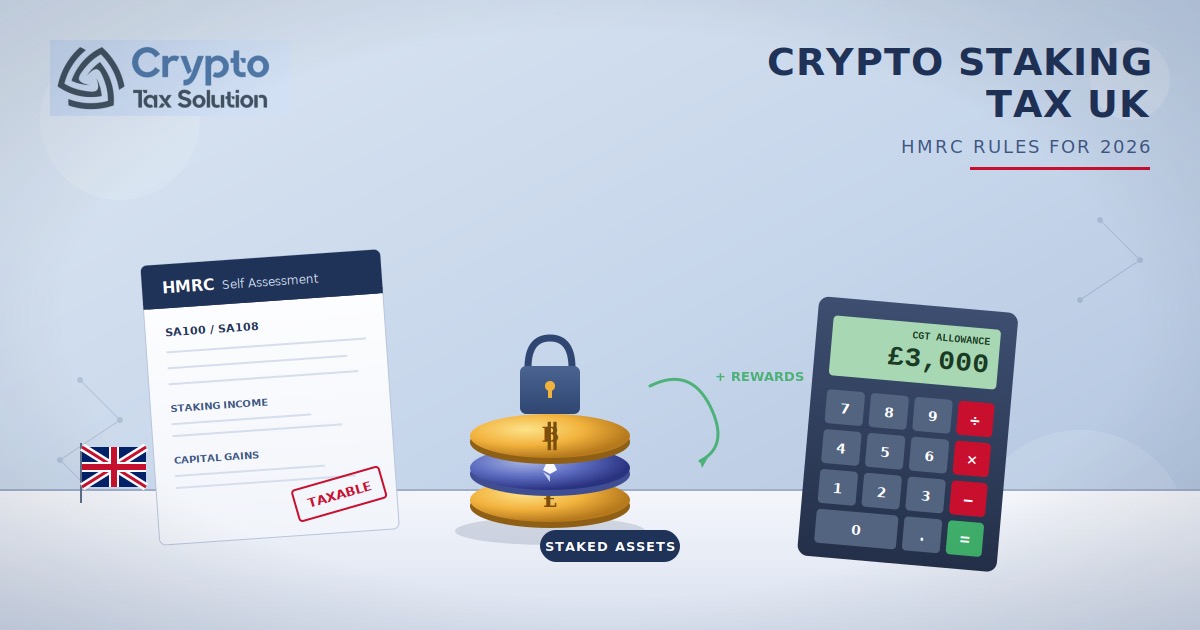
You also have a £3,000 CGT annual exempt amount for 2025/26 and 2026/27. Gains below that threshold across all your disposals (crypto, shares, second properties, anything chargeable) are not taxed. Anything above is. This second event is the part of the crypto staking tax UK picture that catches even experienced investors out.
DeFi staking: where the rules get messier
If you stake through a DeFi protocol such as Lido, Rocket Pool, or any liquid staking platform, the tax picture becomes more complex.
HMRC’s view, published in its February 2022 DeFi guidance and reinforced since, is that the act of staking your tokens through certain DeFi arrangements can itself be a disposal for CGT purposes. The reasoning is that you have given up beneficial ownership of your original tokens in exchange for a new asset (such as stETH or rETH).
What this means in practice:
- When you deposit ETH and receive stETH, that may be a disposal of your ETH, creating a CGT event.
- The stETH you receive becomes a new asset with its own cost basis.
- The rewards you earn through the protocol are still taxable as income.
- When you eventually unwind the position and swap stETH back to ETH, that is another disposal.
HMRC has consulted on changing these rules so that staking and lending through DeFi might be treated as non-disposals in future. As of 2026, no change has been legislated. The current rules still apply, and your crypto staking tax UK calculations should be built on them.
If you are using DeFi staking, you need to be especially careful with your records. The number of taxable events stacks up quickly. Our guide on crypto liquidity pool tax covers similar ground for LP positions.
How to value your staking rewards in GBP
HMRC expects you to use a reasonable valuation method, applied consistently. Accurate GBP values are the foundation of every crypto staking tax UK calculation. In practice, this usually means:
- Use the spot price in GBP on the day the reward was received.
- Use a recognised source such as CoinMarketCap, CoinGecko, or the exchange where you received it.
- Apply the same method across every reward in the tax year. Do not pick and choose.
If you stake with an exchange that pays daily rewards, you will likely have hundreds of micro receipts across the year. Crypto tax software such as Koinly, Recap, or CoinTracker can pull this data automatically and produce HMRC ready reports. For anyone earning more than a few hundred pounds in rewards, this is no longer optional. It is the only realistic way to stay accurate.
Allowances that may reduce your crypto staking tax UK bill
There are a few legitimate ways to reduce your overall liability:
The £1,000 trading allowance. If your total miscellaneous income, including staking, is below £1,000 in the tax year, you do not need to declare it. Above £1,000, the full amount is taxable, but you can choose to deduct either the £1,000 allowance or your actual expenses, whichever is higher.
The £3,000 CGT annual exempt amount. Plan disposals across tax years to make use of this where possible. A couple, where each spouse holds their own crypto, has £6,000 of combined CGT allowance.
Losses. Capital losses from other crypto disposals, or from shares and property, can be offset against your staking gains. Losses must be reported to HMRC within four years to be usable in future years.
Spousal transfers. Transfers between spouses or civil partners are on a no gain, no loss basis. Moving assets to the lower earning partner before disposal is a legitimate planning tool.
What records HMRC expects you to keep
Strong records are the backbone of any solid crypto staking tax UK position. For every staking reward and every later disposal, you should be able to produce:
- The date and time of receipt
- The amount of tokens received
- The GBP value at receipt
- The wallet or platform where the reward landed
- The disposal date and proceeds (when you eventually sell or swap)
- The transaction hashes or exchange references
- Any fees paid
HMRC can request these records up to six years back as standard, and up to twenty years in cases of deliberate non disclosure. With CARF now live, exchanges are reporting your activity directly. Your records need to match. We have a full checklist in our post on crypto tax records UK investors should keep for HMRC.
Common crypto staking tax UK mistakes
A few patterns we see repeatedly in our work with crypto investors:
Assuming staking is tax free until sale. It is not. The income tax event happens at receipt.
Forgetting the second tax event. People remember the income tax when rewards land, then forget that there is still a CGT event later when they sell.
Using the wrong cost basis. If you have paid income tax on a reward, that GBP value becomes your cost basis. Setting it to zero by mistake means you pay tax twice on the same value.
Ignoring liquid staking tokens. Protocols like Lido create extra taxable events that many investors do not realise are happening.
Mixing wallets without records. Moving tokens between your own wallets is not a disposal, but you must still record it. If HMRC cannot trace the flow, they may treat unaccounted amounts as disposals.
How to report staking on your Self Assessment
Crypto staking income goes on the SA100 main Self Assessment return, under “Other UK income” (the miscellaneous income box). Capital gains from later disposals go on the SA108 supplementary pages.
Key deadlines:
- 31 January 2027: Online filing deadline for the 2025/26 tax year
- 31 January 2028: Online filing deadline for the 2026/27 tax year
- 31 October: Paper filing deadline
Tax due is paid by the same date as the online filing deadline.
If you have unreported staking from previous years, HMRC has a Crypto Voluntary Disclosure Service. Coming forward before HMRC contacts you almost always results in lower penalties. For more on what happens if HMRC reaches out first, read our piece on the HMRC crypto enquiry process.
Final thoughts
Crypto staking tax UK rules are not about catching people out. They are about treating staking the way HMRC treats any other form of earned return. Income tax when the reward lands. Capital Gains Tax when you sell. Two events, two calculations, two opportunities to get it wrong.
With CARF now sending your data straight to HMRC, the days of staking quietly and hoping for the best are over. The good news is that with reasonable records and the right reporting, your crypto staking tax UK position is genuinely simple to handle.
If you have been staking for a while and you are not sure whether you have declared it correctly, the most expensive option is doing nothing. The next most expensive is guessing. Speaking to a crypto specialist accountant before HMRC speaks to you is always the cheapest route.
Need help with your crypto staking tax UK position? At Crypto Tax Solution, we work with UK investors every day to get staking, DeFi, and CGT reporting right the first time. Get in touch for a no obligation chat.