
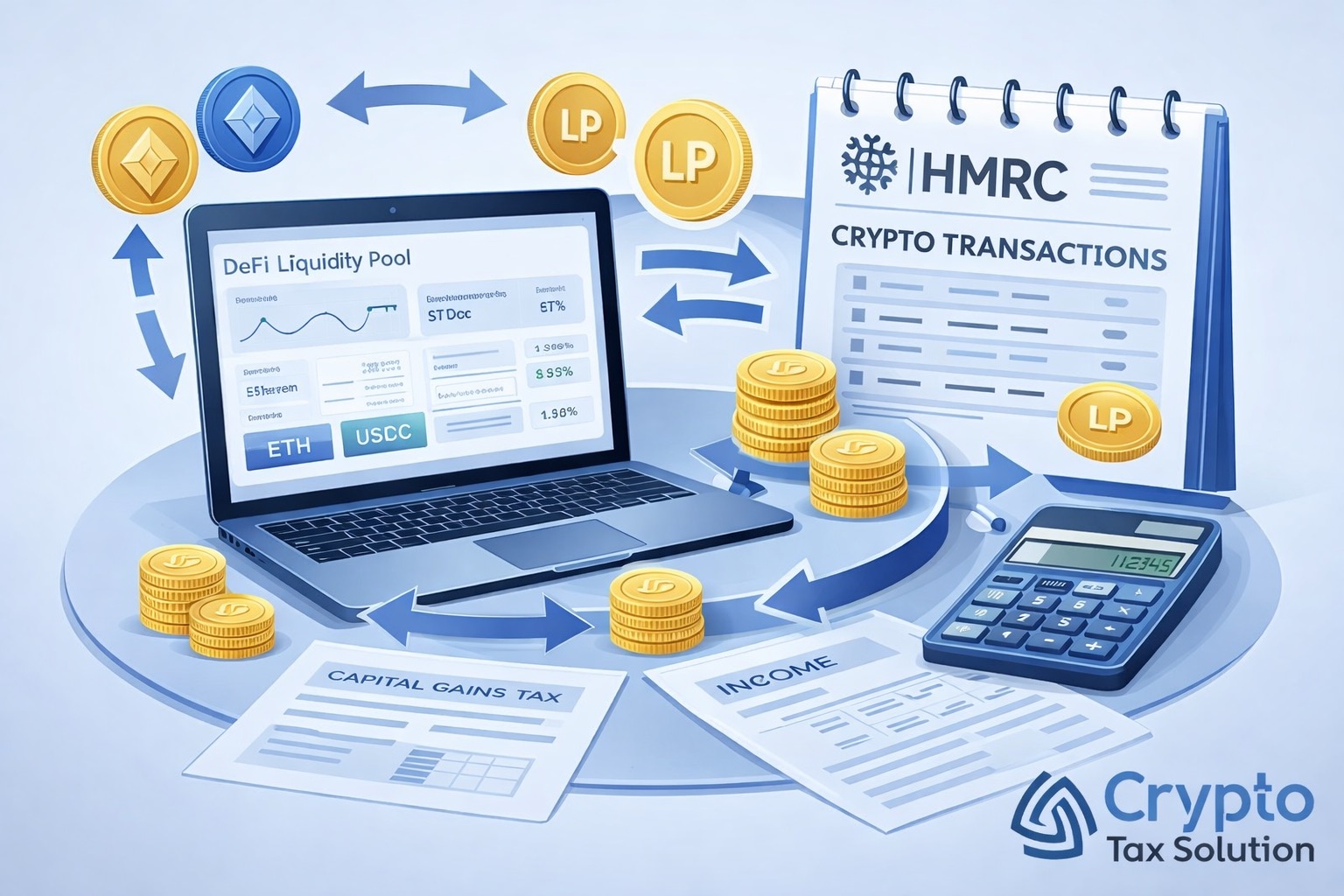
 Crypto liquidity pool tax is one of the most misunderstood areas of DeFi. Many investors jump into liquidity pools for yield without fully understanding the tax consequences. The reality is simple: HMRC does not treat this activity as passive or tax-free.
If you’ve provided liquidity on platforms like Uniswap or PancakeSwap, you may already have multiple taxable events without realising it.
What makes this confusing is that nothing about liquidity pools feels like a traditional sale. You’re not cashing out, just earning yield. But from a tax perspective, exchanging one asset for another is often enough to trigger a taxable event.
Understanding crypto liquidity pool tax early can save a lot of confusion later, especially as DeFi activity becomes more common.
What Is a Liquidity Pool (For Tax Purposes)?
Liquidity pools allow you to deposit two cryptocurrencies into a pool to facilitate trading. In return, you receive LP (liquidity provider) tokens and earn a share of fees.
From a tax perspective, this is where things shift.
When you add assets to a pool, you are no longer just holding crypto. You are typically disposing of one asset and acquiring another.
That’s what creates a tax event.
Liquidity pools allow users to deposit assets into decentralised exchanges to facilitate trading. If you’re new to this, this DeFi guide gives a clear overview of how liquidity pools actually work in practice.
Do You Pay Tax When Adding Liquidity?
Yes, in most cases.
Under crypto liquidity pool tax rules, adding liquidity is usually treated as a disposal for Capital Gains Tax (CGT).
This means:
- You dispose of your original tokens (e.g. ETH and USDC)
- You receive LP tokens in return
- HMRC treats this as a trade
If your assets have increased in value, you may have a capital gain at the point you enter the pool
This is one of the key areas where crypto liquidity pool tax catches investors off guard, as many don’t realise a simple deposit can create a taxable event.
What Happens When You Remove Liquidity?
Removing liquidity is another taxable moment.
When you exit:
- You dispose of LP tokens
- You receive crypto back
Because of how pools work, you may not receive the exact same value or ratio of tokens.
This creates another capital gain or loss, depending on market movement.
Are Liquidity Rewards Taxed?
Yes, and this is where it catches people out.
Rewards from liquidity pools are typically treated as income, not capital gains.
This means:
- Taxed at Income Tax rates when received
- Based on GBP value at that time
- Later subject to CGT when disposed
So you can be taxed more than once across the lifecycle of a single position.
Crypto liquidity pool tax becomes even more complex when income and capital gains overlap within the same position.
Why This Gets Messy Fast
The issue with crypto liquidity pool tax isn’t just the rules. It’s the volume.
A single position can generate:
- Entry transaction
- Multiple reward payments
- Reinvestments
- Exit transaction
That’s a lot of taxable data points from one decision.
If you’re not tracking this properly, it becomes difficult to reconstruct later.
The more activity you have, the harder crypto liquidity pool tax becomes to calculate accurately without proper records.
How HMRC Views This Activity
HMRC generally treats liquidity provision as:
- A series of disposals and acquisitions
- Not passive holding
- Not tax-free
Even though DeFi feels different, from a tax perspective it’s treated in a very traditional way.
HMRC generally treats liquidity provision as a series of disposals and acquisitions rather than passive holding. You can review HMRC’s official position in their cryptoassets manual, which outlines how different types of transactions are assessed.
Common Mistakes Investors Make
One of the biggest mistakes with crypto liquidity pool tax is assuming that nothing happens until you “cash out” into fiat. In reality, most taxable events happen long before that point. Another common issue is ignoring small reward payments, which can add up significantly over time and still need to be reported.
Some investors also treat LP tokens as if they’re the same as the original assets, when they are actually a separate asset for tax purposes. Finally, failing to track transaction fees properly can distort your gain or loss calculations.
These small oversights might not seem important at the time, but they are exactly the kind of inconsistencies that can cause problems if HMRC ever reviews your records.
How to Stay on Top of It
If you’re using liquidity pools, you need structure.
Focus on:
- Recording every transaction
- Tracking GBP values at each step
- Separating income from capital activity
- Keeping consistent records throughout the year
Trying to fix this at year-end is where most people run into problems.
Final Thought
Crypto liquidity pool tax is one of those areas where things look simple on the surface but become complex quickly underneath.
The key isn’t avoiding tax. It’s understanding when it happens.
Because with DeFi, tax doesn’t arrive all at once.
It builds quietly in the background — transaction by transaction — until you finally sit down to report it.
Getting crypto liquidity pool tax right isn’t about avoiding tax, it’s about understanding when and why it applies.
Enjoyed this? Check out our other blogs here.