
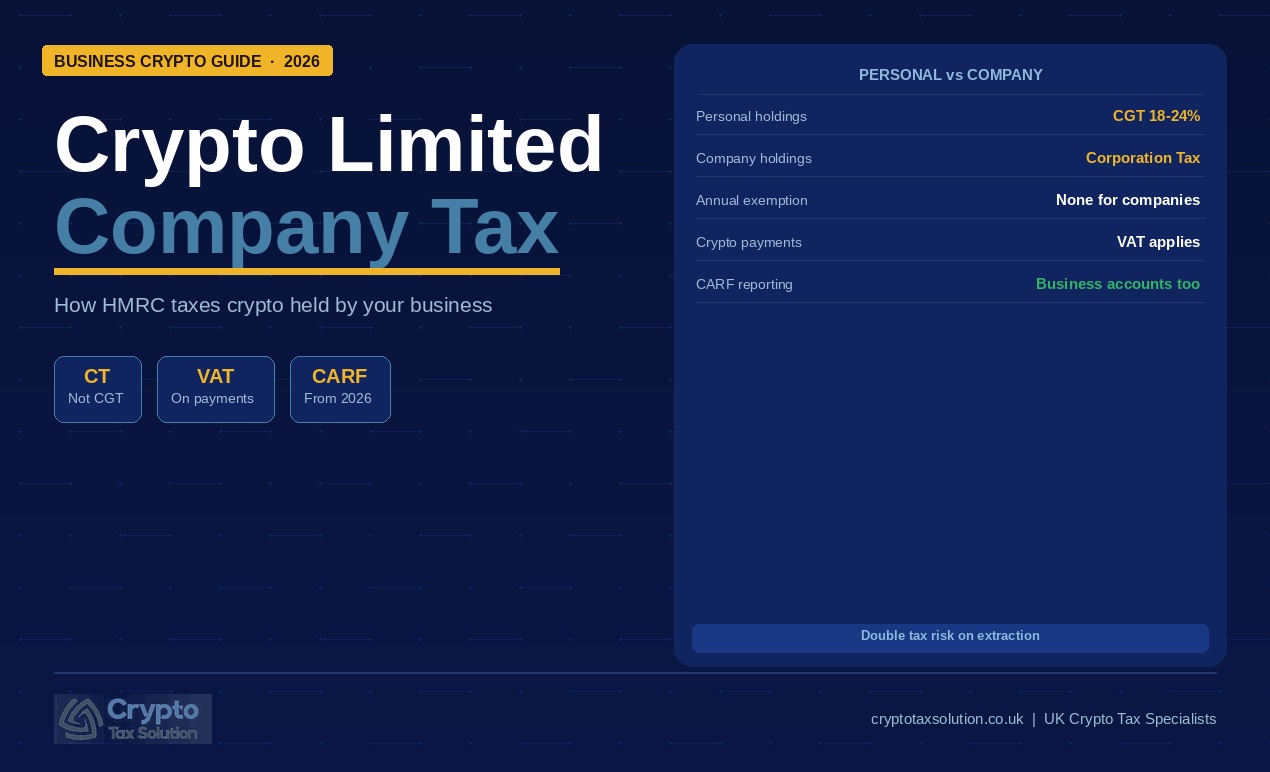
 Crypto limited company tax is a completely different regime to the personal crypto tax rules most investors are familiar with. If your business holds cryptoassets on its balance sheet, accepts crypto as payment, or trades crypto through the company, none of the personal Capital Gains Tax rules apply. Instead, your company is taxed under Corporation Tax, and the calculations, deadlines, and reporting requirements work differently from top to bottom.
This guide explains exactly how crypto limited company tax works in the UK, covering holdings, trading, accepting crypto payments, and the accounting treatment HMRC expects. At Crypto Tax Solution, we work with businesses as well as individual investors, and this is one of the areas we see the most confusion around.
Why Crypto Limited Company Tax Is Different From Personal Crypto Tax
If you have researched personal crypto tax, you will know the rules centre on Capital Gains Tax, an 18% or 24% rate, and a £3,000 annual exempt amount. None of that applies once crypto sits inside a limited company.
A company is a separate legal entity from its directors and shareholders. When a limited company disposes of a cryptoasset at a profit, that gain is not subject to personal Capital Gains Tax at all. It is added to the company’s taxable profits and charged to Corporation Tax instead, alongside the rest of the company’s trading income. There is no separate crypto exempt amount for companies, and the personal CGT rates simply do not feature anywhere in the calculation.
How Corporation Tax Applies to Company Crypto Holdings
When a company buys and later sells cryptoassets at a profit, that gain forms part of the company’s taxable profits for the accounting period. It is taxed at the applicable Corporation Tax rate for that period, currently structured around a small profits rate, a marginal relief band, and a main rate depending on the level of the company’s total profits.
For a full breakdown of current Corporation Tax rates and how marginal relief works, see our sister company’s guide to Corporation Tax rates 2026 at Sepera Accounting.
Whether the gain is treated as a capital gain within the Corporation Tax computation, or as trading income, depends on why the company holds the crypto in the first place. This distinction matters more than almost anything else in crypto limited company tax.
Trading vs Investment: Why the Distinction Matters for Your Company
HMRC looks at the nature and frequency of your company’s crypto activity to determine whether it is trading in cryptoassets or simply holding them as an investment. This mirrors the trader versus investor distinction that applies to individuals, but the consequences are structured differently within Corporation Tax.
If the company is trading in cryptoassets (frequent buying and selling, organised activity, a commercial pattern resembling a trading business), profits are treated as trading income and taxed as part of the company’s normal trading profits.
If the company holds crypto as an investment (infrequent transactions, held for long-term appreciation rather than active trading), gains are typically treated as chargeable gains within the Corporation Tax computation, following broadly similar principles to how capital gains work for companies generally.
Loan relationship rules and intangible fixed asset rules can also apply depending on how the crypto is classified in the company’s accounts, adding a further layer most business owners are not expecting. Getting this classification right at the outset avoids a painful reclassification later.
Accepting Cryptocurrency as Payment for Goods or Services
If your business accepts crypto as payment, the tax treatment is more straightforward but still requires care. You must record the GBP value of the cryptoasset at the point you receive it, and that GBP value is treated as your sale proceeds for both Corporation Tax and VAT purposes.
A transaction where a customer pays in crypto is treated as a barter transaction for VAT purposes: two supplies happening simultaneously, the goods or service you provided and the cryptoasset received in exchange. VAT is due on your supply based on the GBP value at the time, exactly as if the customer had paid in sterling.
If you subsequently hold the crypto received rather than converting it immediately, any later increase or decrease in value is a separate event, taxed under the trading versus investment principles above, depending on how the company treats the asset going forward.
Crypto Limited Company Tax: What Records You Need to Keep
HMRC expects the same standard of record keeping for company crypto activity as for any other business transaction, but crypto adds complexity because of volatility and the number of platforms often involved.
At minimum, your company should retain:
- The GBP value of every crypto transaction at the date and time it occurred
- Records of which wallet or exchange each transaction relates to
- Evidence of the cost basis for any crypto disposed of
- Documentation supporting whether holdings are treated as trading stock or investment assets
- Records of any crypto received as payment, including the customer, service provided, and GBP value at receipt
Reconstructing this after the fact across multiple wallets and exchanges is one of the most time-consuming parts of preparing company accounts involving crypto. Our pricing page sets out the cost of a full transaction reconstruction service.
Directors Holding Crypto Personally vs Through the Company
A common question from limited company directors is whether to hold crypto personally or through the business. There is no universally correct answer, and it depends heavily on your individual circumstances, but the key differences worth weighing are:
Personal holdings are taxed under Capital Gains Tax with access to the £3,000 annual exempt amount and rates of 18% or 24%. You retain full personal control and there is no interaction with your company’s accounts.
Company holdings are taxed under Corporation Tax with no separate exempt amount, but gains sit within the company rather than triggering a personal tax event. Extracting the value later, through salary or dividends, then creates a further tax charge at the personal level, meaning company-held crypto can face a double layer of tax by the time you actually benefit from it personally.
This double taxation risk is often overlooked and can make personal holding more tax-efficient for straightforward investment purposes, while company holding tends to make more sense where crypto is genuinely part of the business’s trading activity.
How CARF Affects Crypto Limited Company Tax Compliance
From 2026, the Crypto-Asset Reporting Framework (CARF) requires crypto exchanges and service providers to collect and report detailed transaction data, including for business and corporate accounts, not just individual investors. HMRC is building a dedicated reporting service ahead of first international data exchanges expected by 30 September 2027.
This means company crypto accounts held on regulated exchanges will increasingly be visible to HMRC in the same way personal accounts already are. Businesses that have not been correctly accounting for crypto gains, trading income, or crypto payments received should address this now rather than waiting for HMRC to raise a query following CARF data exchange.
What Happens if Your Company Has Historic Undeclared Crypto Gains?
If your company has previously undeclared crypto activity, HMRC’s penalty framework rewards coming forward before you are contacted. Broadly, penalties for careless errors range from 0% to 30% of the tax due for unprompted disclosure, rising to 15% to 30% if HMRC has already made contact. Deliberate but not concealed errors carry penalties of 20% to 70% for unprompted disclosure, again materially higher once HMRC has prompted you.
Correcting historic company crypto tax positions is a specialist area. If your business has crypto history that has not been fully accounted for, get advice before HMRC’s data catches up with your company’s accounts.
How Crypto Tax Solution Helps With Crypto Limited Company Tax
We support businesses navigating the Corporation Tax treatment of crypto holdings, crypto trading activity, and crypto accepted as payment. This includes classifying holdings correctly as trading or investment assets, reconstructing transaction histories across exchanges, and preparing the figures your accountant needs for your company’s Corporation Tax return.
We work alongside Sepera Accounting’s limited company accounting service as part of the wider Sepera Group, giving businesses a joined-up approach to both the crypto-specific calculations and the wider Corporation Tax return. Get in touch via our contact page to discuss your company’s crypto position.
Frequently Asked Questions: Crypto Limited Company Tax
Is company crypto taxed the same as personal crypto?
No. Personal crypto holdings are taxed under Capital Gains Tax at 18% or 24% with a £3,000 annual exempt amount. Crypto held by a limited company is taxed under Corporation Tax instead, with no separate exempt amount, as part of the company’s overall taxable profits.
How does HMRC decide if a company is trading or investing in crypto?
HMRC looks at the frequency, organisation, and commercial nature of the company’s crypto activity. Frequent, organised buying and selling resembling a trading business points toward trading income treatment, while infrequent transactions held for long-term appreciation typically point toward investment treatment as chargeable gains.
Do I need to charge VAT if my business accepts crypto payments?
Yes. Accepting crypto as payment is treated as a barter transaction for VAT purposes. VAT is due on your supply based on the GBP value of the crypto at the time of the transaction, exactly as if the customer had paid in pounds sterling.
Is it better to hold crypto personally or through my limited company?
It depends on your circumstances. Personal holdings benefit from the CGT annual exempt amount and avoid the double taxation risk of extracting company profits later. Company holdings can make more sense where crypto genuinely forms part of the business’s trading activity rather than being a personal investment routed through the company.
What Corporation Tax rate applies to company crypto gains?
Crypto gains are added to the company’s total taxable profits and taxed at the applicable Corporation Tax rate for the accounting period, which depends on the level of the company’s overall profits and whether marginal relief applies.
Does CARF apply to business crypto accounts, not just personal ones?
Yes. The Crypto-Asset Reporting Framework applies to crypto accounts held by businesses and companies as well as individuals. Exchanges and service providers are required to collect and report transaction data across all account types, increasing HMRC’s visibility of company crypto activity.
What records does my company need to keep for crypto transactions?
Your company should keep the GBP value of every transaction at the time it occurred, records of which wallet or exchange was used, cost basis evidence for any disposals, and documentation supporting whether holdings are treated as trading stock or investment assets.
What happens if my company hasn’t declared crypto gains correctly in the past?
Penalties are significantly lower for unprompted voluntary disclosure than for disclosure prompted by an HMRC enquiry. Careless errors carry penalties of 0% to 30% unprompted, rising to 15% to 30% if prompted. Getting ahead of HMRC’s data is always the better position.
Can extracting company crypto gains create a second tax charge?
Yes. Once a company gain is taxed under Corporation Tax, extracting that value personally through salary or dividends creates a further personal tax charge. This double layer of tax is a key reason some business owners prefer to hold investment-purpose crypto personally rather than through the company.
Do I need a specialist for crypto limited company tax, or can my regular accountant handle it?
Many general accountants are unfamiliar with the specific classification issues around trading versus investment crypto holdings and the reconstruction of multi-exchange transaction histories. Specialist crypto tax support alongside your company accountant reduces the risk of an incorrect classification affecting your Corporation Tax return.
This article provides general guidance on crypto limited company tax in the UK. Corporation Tax rules and HMRC’s crypto guidance can change. Please contact Crypto Tax Solution for advice tailored to your company’s specific situation.