
 Paid in crypto? You are part of a fast-growing group, and almost everyone in it is confused about the same two things: what tax hits when the tokens arrive, and what tax hits when you eventually sell them. The confusion is understandable, because being paid in crypto triggers two entirely separate tax events that most guides blur into one.
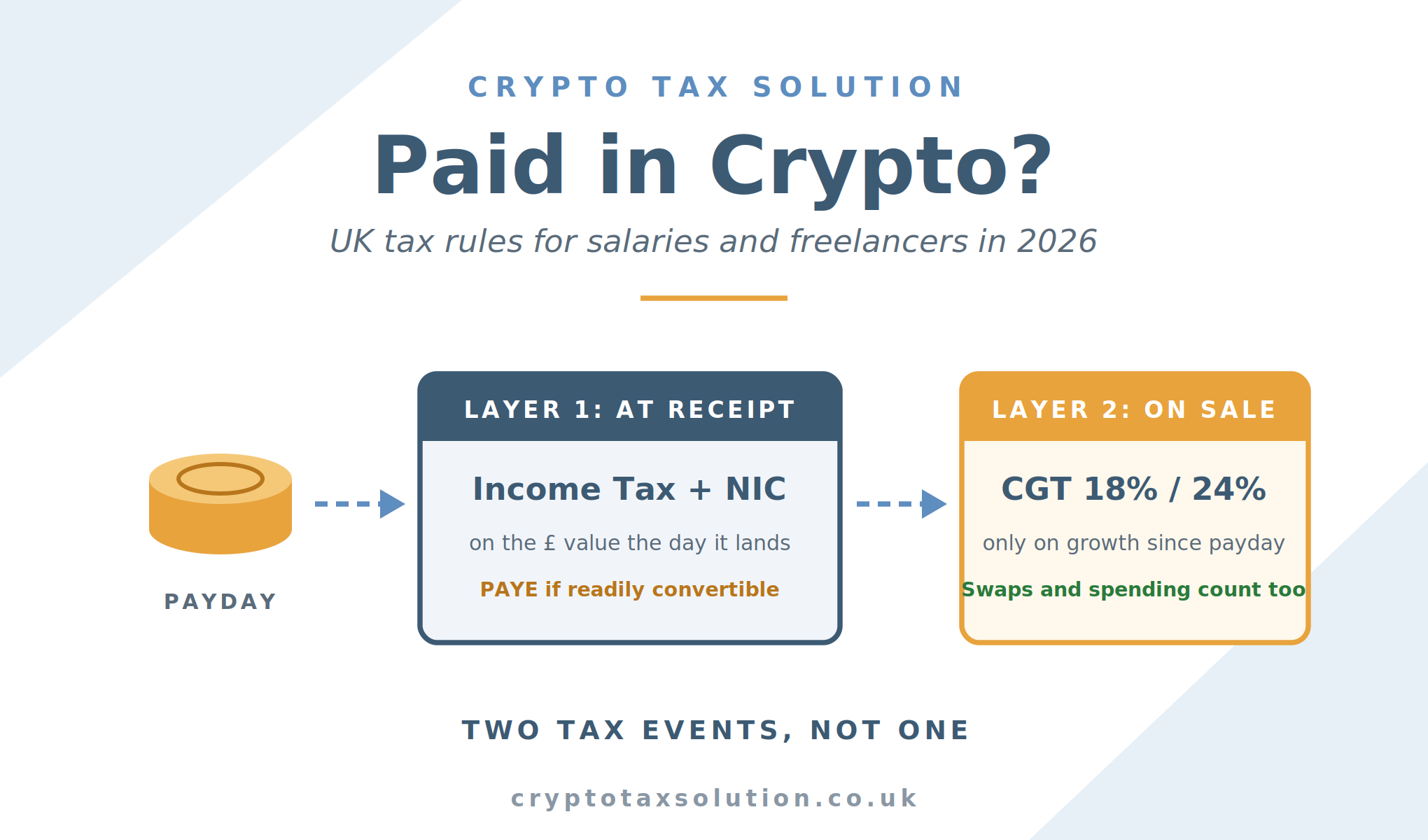
The quick answer: crypto received as pay is taxed as ordinary income (Income Tax and National Insurance) on its sterling value on the day you receive it, exactly like salary. If you later sell, swap or spend those tokens, any change in value since that day is a separate Capital Gains Tax event. Income tax first, CGT later, two different calculations.
This guide covers how being paid in crypto works for employees and freelancers in 2026: the readily convertible asset rule that forces most crypto pay through PAYE, the 90-day reimbursement trap that creates tax on tax, the second CGT layer everyone forgets, minimum wage rules, and what CARF reporting means for people whose income arrives on-chain.
How is a crypto salary taxed for employees?
If you are paid in crypto by an employer, HMRC treats the tokens as “money’s worth”: employment income taxed on the sterling market value at the date of receipt. Whether that tax is collected through payroll depends on one question: are the tokens a readily convertible asset (RCA)?
- RCA tokens (almost all of them). A cryptoasset is an RCA if trading arrangements exist to turn it into cash, which covers Bitcoin, Ether, major stablecoins and essentially anything listed on an exchange. Being paid in crypto that is an RCA means your employer must operate PAYE: Income Tax and employee Class 1 National Insurance are deducted through payroll on the sterling value, employer NIC is due on top, and the payment is reported to HMRC on a Full Payment Submission like any salary.
- Non-RCA tokens (rare). Genuinely illiquid tokens with no trading arrangements fall outside PAYE. You declare the value yourself on the employment pages of your Self Assessment return and pay the tax through it.
In practice, if you are being paid in crypto you can actually spend, it is an RCA and payroll rules apply. An employer paying crypto salaries without operating PAYE is building a compliance problem for both sides.
The 90-day trap: how crypto pay becomes tax on tax
Here is the mechanism that ambushes everyone paid in crypto, employers and employees alike. PAYE must be paid to HMRC in sterling, but the salary went out in tokens, so there is often no cash from which to deduct the tax. The employer pays HMRC out of its own money on the employee’s behalf, and the employee is expected to reimburse the employer.
If the employee does not make good that tax within 90 days of the end of the tax year, the unreimbursed amount is itself treated as a further taxable benefit, reported on form P11D and taxed again. Tax on tax, entirely avoidable, and one of the most common genuine errors we see when reviewing arrangements where staff are paid in crypto. The clean solutions are simple: pay a sterling portion sufficient to cover all deductions, or diarise the reimbursement properly.
Can my whole salary legally be paid in crypto?
Usually not. National Minimum Wage rules require wages to be paid in money, and crypto does not count as money for these purposes. The NMW element of any package must therefore be paid in actual currency, with crypto layered on top. For higher earners this is academic; for junior staff on packages near the minimum wage, a 100% crypto salary is a compliance breach before any tax question arises. The standard compliant structure is hybrid: sterling base covering at least NMW and the tax deductions, crypto as the balance.
How are freelancers and contractors taxed when paid in crypto?
Invoice a client and get paid in crypto as a self-employed person, and the tax logic of being paid in crypto follows the trading rules: the sterling market value of the tokens on the date of receipt is your trading income, exactly as if the client had paid the invoice in pounds. That value goes into your accounts, is taxed at your Income Tax rates, and carries Class 4 (and where applicable Class 2) National Insurance as normal self-employed profit.
Three practical points matter for freelancers being paid in crypto:
- Record the sterling value on the day, every time. Your income figure is fixed at receipt, regardless of what the token does afterwards. A screenshot of the exchange rate alongside the invoice is the habit that saves you at enquiry time.
- Volatility does not reduce your income. If you invoice £5,000, receive tokens worth £5,000, and they fall to £3,000 before you sell, your trading income is still £5,000. The £2,000 fall is a capital loss on disposal, usable against gains, not against the income. This asymmetry surprises everyone.
- Set the tax aside in sterling immediately. The liability is a sterling number owed on payment-on-account dates; holding the tax reserve in the volatile asset that created it is speculation with HMRC’s money.
The second layer: CGT when you sell what you were paid
The income tax at receipt is only half the paid in crypto story. From the moment the tokens land, you hold an investment with an acquisition cost equal to the value already taxed as income. Sell, swap for another token, or spend them later, and the difference between that acquisition cost and the disposal value is a capital gain or loss:
- Gains above the £3,000 annual exempt amount are taxed at 18% or 24% depending on your band.
- Swapping the tokens for another cryptoasset is a disposal, not a neutral event, and spending them on goods or services is too.
- Pooling and the 30-day rules apply to the tokens alongside anything else you hold in the same asset.
The comforting flip side: because the value at receipt was taxed as income, it is not taxed again. Only the movement after receipt faces CGT. Someone paid in crypto who converts to sterling the same day typically has income tax and a negligible capital gain, which is exactly why same-day conversion is the low-admin choice for people who do not want the investment exposure.
Does HMRC know I am being paid in crypto?
Increasingly, yes. Being paid in crypto is no longer invisible: under the Crypto-Asset Reporting Framework, in force since 1 January 2026, UK crypto service providers must collect and report customer transaction data to HMRC, with international exchange between jurisdictions following. Wallets receiving regular inbound transfers from an employer or clients are visible, matchable to tax returns, and precisely the pattern automated compliance checks are built to find. Our CARF guide explains what is reported, and if the past has gaps, better to fix them before the nudge letter arrives than after.
Frequently Asked Questions
Do I pay tax if I am paid in crypto in the UK?
Yes. Crypto received as payment for work is taxed as income on its sterling market value on the date of receipt: through PAYE with National Insurance for employees receiving readily convertible tokens, or as trading income via Self Assessment for the self-employed. A later sale, swap or spend of the tokens is a separate Capital Gains Tax event.
Is being paid in crypto taxed twice?
Not on the same value. The value at receipt is taxed once as income. Only the growth (or loss) between receipt and disposal falls into Capital Gains Tax. Someone who converts to sterling immediately after being paid in crypto has essentially no capital gain, just the income tax.
What is a readily convertible asset for crypto salaries?
A cryptoasset with trading arrangements that allow it to be turned into cash, which includes Bitcoin, Ether, major stablecoins and effectively anything exchange-listed. RCA status obliges the employer to operate PAYE and deduct Income Tax and Class 1 National Insurance on the sterling value, with employer NIC due on top.
Can my employer pay my full salary in Bitcoin?
Only if the package stays compliant: National Minimum Wage must be paid in money, and PAYE deductions must reach HMRC in sterling. The workable structure is a sterling base covering NMW and deductions, with crypto on top, and any tax the employer funds on your behalf reimbursed within 90 days of the tax year end to avoid a further tax charge.
How do I value crypto payments for my tax return?
Use the sterling market value on the date of receipt, applied consistently from a reputable exchange or price source, and keep the evidence. That value sets both your taxable income and your CGT acquisition cost for the same tokens.
What if the crypto I was paid in falls in value before I sell?
Your income remains the value at receipt; the fall becomes a capital loss when you dispose, claimable against capital gains rather than against the income. This mismatch is the strongest practical argument for converting enough to sterling at payment to cover your tax.
Do freelancers pay National Insurance on crypto income?
Yes, where the activity is a trade: crypto-paid invoices join sterling ones in your self-employed profits, attracting Class 4 (and any Class 2) National Insurance as normal. One-off or non-trade receipts may instead be miscellaneous income, which typically carries no NIC; the boundary is fact-specific and worth professional review.
Get the structure right before payday
Being paid in crypto is entirely workable under UK tax law; what fails is improvisation. Employees need the RCA payroll treatment and the reimbursement handled; employers need NMW and PAYE mechanics built into the package; freelancers need day-of-receipt valuations, a sterling tax reserve, and clean records connecting invoices to wallets. All of it is straightforward when designed in advance and expensive when reconstructed under enquiry.
At Crypto Tax Solution we set up and review crypto payment arrangements for employees, employers and the self-employed, calculate both tax layers correctly, and repair historic gaps before HMRC finds them. Get in touch to get your position checked. For HMRC’s official guidance on receiving cryptoassets, see gov.uk.