
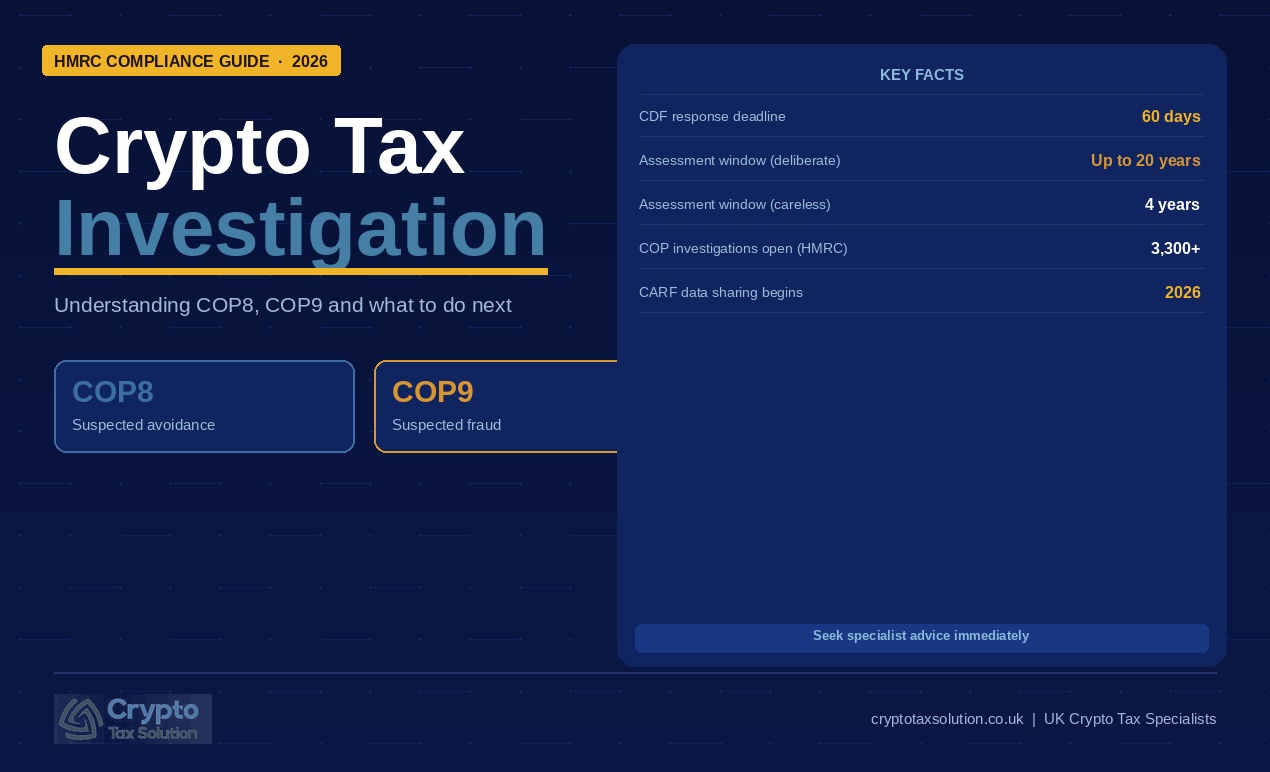
 A crypto tax investigation from HMRC is a materially different situation to a nudge letter or a routine compliance check. If you have received correspondence referencing Code of Practice 8 or Code of Practice 9, HMRC believes there is a serious issue with your tax affairs, and how you respond in the first days matters enormously. This guide explains what these investigations actually are, how they differ, and what steps to take if you find yourself facing one.
If you have simply received a nudge letter prompting you to review your crypto tax position, that is a different and far less serious situation, covered in our guide to HMRC crypto nudge letters. This article deals specifically with formal investigations under COP8 and COP9. At Crypto Tax Solution, we help UK crypto investors understand exactly where they stand and what their options are.
What Triggers a Crypto Tax Investigation?
HMRC’s case selection combines risk-based intelligence with third-party data. For crypto specifically, exchanges operating in the UK and increasingly overseas platforms under the incoming Crypto-Asset Reporting Framework (CARF) supply transaction data directly to HMRC. When declared income or gains on a self assessment return do not align with the data HMRC holds, or where patterns suggest deliberate underreporting, a case can escalate from a routine enquiry into a formal investigation.
Common triggers include large, undeclared disposals visible through exchange reporting, inconsistent explanations given during an earlier compliance check, offshore exchange accounts, and information received from informants or other government agencies. The key distinction that determines which Code of Practice applies is whether HMRC suspects an innocent or careless error, or deliberate wrongdoing.
COP8: Investigating Suspected Avoidance
Code of Practice 8 is used where HMRC suspects significant tax loss arising from complex arrangements or aggressive tax planning, without necessarily alleging fraud at the outset. A COP8 crypto tax investigation typically involves prolonged scrutiny of your tax returns, exchange records, and banking history, often using HMRC’s statutory information-gathering powers under Schedule 36.
Being under COP8 does not automatically mean HMRC believes you have committed fraud, but it should be taken every bit as seriously. A COP8 investigation can escalate to COP9 if HMRC uncovers evidence of deliberate misrepresentation, if explanations given during the enquiry are inconsistent, or if the true scale of the tax loss turns out to be materially greater than first suspected.
COP9: Investigating Suspected Fraud
Code of Practice 9 is HMRC’s civil procedure for cases where deliberate tax fraud is suspected. This is significantly more serious than COP8. A COP9 letter is issued by HMRC’s Fraud Investigation Service and comes with an offer to participate in the Contractual Disclosure Facility (CDF), a formal, one-time opportunity to make a complete and honest disclosure in exchange for HMRC’s commitment not to pursue criminal prosecution for the matters disclosed.
This is where the process becomes genuinely high stakes. You have 60 days from receiving the CDF offer to decide whether to accept it. Accepting requires you to admit deliberate wrongdoing, provide an outline disclosure describing the fraud and the period it covers, and later submit a full, formally certified disclosure covering every irregularity in your tax affairs, not just crypto, and not just the matters HMRC already suspects.
Rejecting the CDF offer, or accepting it but failing to make a complete and accurate disclosure, removes HMRC’s commitment not to prosecute and materially increases the risk of a criminal investigation. This decision should never be made without specialist advice, and it should not be made quickly out of panic either way.
How a Crypto Tax Investigation Can Escalate
The line between COP8 and COP9 is not fixed at the outset. A COP8 crypto tax investigation can move to COP9 partway through if HMRC’s investigators uncover deliberate conduct during their review. This is one of the most important practical points to understand: how you respond to a COP8 enquiry can directly influence whether it escalates.
Inconsistent explanations, incomplete disclosure, or documents that contradict earlier statements are commonly cited reasons for escalation. This is why professional representation from the point of first contact, rather than after a problem has already emerged, tends to produce materially better outcomes.
What HMRC’s Investigation Data Shows
These are not rare, isolated cases. In the year to 31 March 2023, HMRC opened over 1,000 Code of Practice investigations, split between COP8 and COP9, and had more than 3,000 such investigations under way at any one time. Investigations closed in that period generated substantial recoveries for HMRC across both codes, reflecting how seriously and consistently these powers are used, not as an occasional exercise but as an ongoing enforcement programme.
With CARF bringing significantly more exchange and platform data into HMRC’s hands from 2026 onwards, crypto-specific cases are a growing proportion of this activity, not a shrinking one.
How Far Back Can HMRC Go?
Where deliberate behaviour is established, HMRC can assess tax going back up to 20 years. This is dramatically longer than the standard four-year assessment window that applies to genuine mistakes, and it is one of the clearest illustrations of why the distinction between careless error and deliberate conduct matters so much to the final financial outcome of a crypto tax investigation.
What to Do If You Receive a COP8 or COP9 Letter
Do not ignore it, and do not respond immediately without advice. Both reactions carry real risk. Ignoring correspondence from HMRC’s Fraud Investigation Service allows deadlines to pass and options to close. Responding hastily, before understanding the full picture of your own tax history, can lock you into an account of events that is difficult to correct later.
Get specialist advice immediately. This is not a situation for a general accountant unfamiliar with HMRC’s fraud investigation procedures, or for self-representation. The stakes, the 60-day CDF deadline under COP9, and the technical complexity of crypto transaction reconstruction all point toward specialist involvement from day one.
Gather your records, but do not volunteer beyond what is requested. Statutory information notices must be complied with, but cooperation does not mean handing over more material than is asked for. Scope matters, and a specialist adviser will help control what is disclosed and when.
Be honest with your adviser, even where it is uncomfortable. The strategy available to you depends entirely on an accurate picture of what has actually happened. Advisers cannot build an effective response around a partial or misleading account of your own history.
How This Differs From an HMRC Nudge Letter
It is worth being clear about the distinction, because the two are often confused. A nudge letter is a prompt, based on data HMRC holds, encouraging you to review your position and make a voluntary correction if needed. There is no formal investigation opened, no CDF offer, and no allegation of wrongdoing. Our guide to crypto nudge letters explains how to respond to that situation, which is considerably more manageable.
A COP8 or COP9 crypto tax investigation is a different order of magnitude. HMRC has already formed a specific suspicion and has opened a formal case with defined legal processes, statutory powers, and, in the case of COP9, an explicit reference to fraud.
How Crypto Tax Solution Helps
Reconstructing an accurate crypto transaction history across multiple exchanges, wallets, and years is often the single hardest technical part of responding to a crypto tax investigation, and it is exactly where we specialise. We work through your full trading history, apply the correct share pooling and cost basis rules, and produce figures your legal and tax representation can rely on.
For a full explanation of the underlying capital gains rules that most crypto tax investigations turn on, see our guide to crypto capital gains tax, and if the investigation involves a limited company holding or trading crypto, our guide to crypto limited company tax explains how Corporation Tax treatment differs from personal CGT.
If you are already under investigation, get in touch via our contact page as early as possible. See our prices page for the cost of a full transaction reconstruction. You can also read HMRC’s own Code of Practice 9 guidance directly on GOV.UK.
Frequently Asked Questions: Crypto Tax Investigation
What is a crypto tax investigation?
It is a formal HMRC enquiry into suspected significant errors, avoidance, or fraud in a person’s crypto-related tax affairs, conducted under Code of Practice 8 or Code of Practice 9. It is materially more serious than a nudge letter or a standard compliance check.
What is the difference between COP8 and COP9?
COP8 investigates significant tax loss from complex arrangements or avoidance, without necessarily alleging fraud at the outset. COP9 is used specifically where HMRC suspects deliberate tax fraud, and comes with an offer to enter the Contractual Disclosure Facility in exchange for protection from criminal prosecution.
What is the Contractual Disclosure Facility?
The CDF is a formal contract offered under COP9, under which the taxpayer makes a complete and honest disclosure of all deliberate behaviour and irregularities, in return for HMRC’s commitment not to pursue criminal prosecution for the disclosed conduct. It requires an admission of deliberate wrongdoing.
How long do I have to respond to a COP9 letter?
You typically have 60 days from receiving the CDF offer to decide whether to accept it and submit an outline disclosure. This is a fixed and important deadline, and specialist advice should be sought as early as possible within that window.
Can a COP8 investigation turn into a COP9 investigation?
Yes. A COP8 investigation can escalate to COP9 if HMRC uncovers evidence of deliberate misrepresentation or concealment during the enquiry, or if the taxpayer provides inconsistent or misleading information. How the COP8 stage is handled can directly affect whether escalation occurs.
How far back can HMRC investigate crypto tax affairs?
Where deliberate behaviour is established, HMRC can assess tax going back up to 20 years, compared with the standard four-year window for genuine errors. This is one of the most significant financial consequences of a case being treated as deliberate rather than careless.
What happens if I reject the CDF offer?
Rejecting the CDF offer removes HMRC’s commitment not to pursue criminal prosecution and significantly increases the risk of a criminal investigation. This decision carries serious consequences either way and should never be made without specialist legal and tax advice.
How is this different from an HMRC nudge letter?
A nudge letter is an informal prompt encouraging voluntary review and correction, with no formal investigation opened. A COP8 or COP9 crypto tax investigation is a formal legal process with statutory powers, defined disclosure requirements, and, under COP9, an explicit suspicion of fraud.
Do I need a specialist for a crypto tax investigation, or can my regular accountant help?
Given the technical complexity of reconstructing crypto transaction histories and the serious legal stakes involved in COP8 and COP9 procedures, specialist representation experienced in both crypto tax and HMRC fraud investigation procedures is strongly advisable rather than relying on general accounting support alone.
What triggers HMRC to open a crypto tax investigation?
Common triggers include mismatches between declared income and exchange data reported to HMRC, inconsistent explanations given during an earlier enquiry, undeclared offshore exchange accounts, and information from third parties. Data sharing under the Crypto-Asset Reporting Framework is expected to increase the volume of such cases significantly from 2026.
This article provides general educational guidance on HMRC crypto tax investigations and does not constitute legal or tax advice. If you have received correspondence referencing Code of Practice 8 or Code of Practice 9, seek specialist advice immediately. This article’s content is accurate as of publication, based on published GOV.UK guidance and current professional commentary, but investigation procedures can change.