
 Nobody enjoys crypto losses, but there is one consolation the UK tax system offers: claimed properly, losses reduce the Capital Gains Tax you pay on your winners, this year and for years to come. The catch is in those two words, claimed properly. Crypto losses don’t work automatically, they come with a deadline, and some of the losses people assume they can claim, scams, lost keys, frozen exchanges, follow special rules that catch almost everyone out.
At Crypto Tax Solution, loss claims are where we find the most money for clients, and also where we see the most DIY mistakes. This guide covers how crypto losses actually work for UK tax, the offset order, the 4-year claim deadline, what happens with worthless tokens and stolen coins, and the 5 steps to turn a bad year in the market into a smaller tax bill.
Do Crypto Losses Reduce Your UK Tax Bill?
Yes. Cryptoassets are treated as property for UK tax, so disposing of crypto for less than it cost you creates a capital loss, the mirror image of a capital gain. Crypto losses offset capital gains, from crypto or from any other asset, shares and property included, which reduces the amount exposed to Capital Gains Tax at 18% or 24%. With the annual exempt amount now just £3,000, almost anyone with gains has tax to save, which makes unclaimed crypto losses genuinely wasted money.
The framework sits inside the same rules we covered in our full UK crypto tax guide: the same definition of a disposal, the same pound valuations, and the same matching rules all apply to losses just as they do to gains.
So why do so many crypto losses go unclaimed? Three reasons come up constantly. People don’t realise losses need claiming at all, assuming HMRC somehow nets things off automatically. People with only losses in a year file nothing, not knowing they’re letting a deadline run. And people who lost money to dead tokens, scams or collapsed platforms assume either that relief is automatic or that none exists, when the truth for each sits somewhere specific in between. This guide deals with all three, because every one of them has a fix.
When Do Crypto Losses Actually Arise?
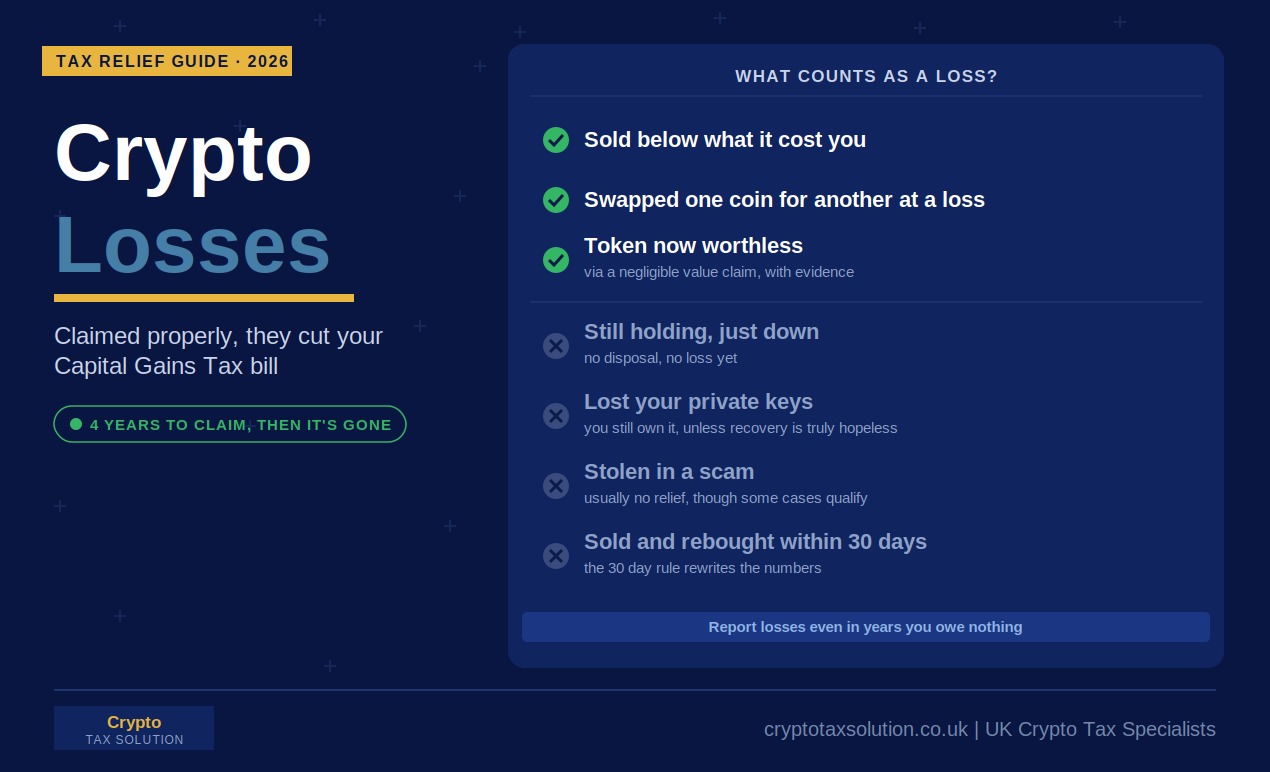
A loss needs a disposal, exactly like a gain. You realise crypto losses when you:
- Sell a cryptoasset for less than its allowable cost
- Swap one coin for another when the coin you give up is worth less than it cost you
- Spend crypto that has fallen in value since you acquired it
- Gift crypto (to anyone other than your spouse or civil partner) when it’s worth less than it cost
What doesn’t create a loss: watching your portfolio fall. A coin that’s down 80% but still in your wallet is an unrealised loss, invisible to HMRC until you dispose of it. And the cost you measure against isn’t necessarily what you personally remember paying, it’s the cost produced by HMRC’s matching rules, same day first, then the following 30 days, then your Section 104 pool. For active traders those rules can move the numbers a long way from gut feel, in either direction.
How Offsetting Crypto Losses Works
The order matters, and it isn’t always generous:
- Same-year losses first. Losses realised in a tax year are set against that year’s gains automatically, and here’s the sting: they must be used even if it wastes your £3,000 annual exempt amount. You can’t save same-year crypto losses for later while sheltering this year’s gains with the allowance.
- Then carry forward. Losses you can’t use this year carry forward indefinitely once claimed, and carried-forward losses are kinder: you only use enough of them to bring future gains down to the annual exempt amount, preserving the rest.
That asymmetry is why timing disposals thoughtfully matters. Realising losses and gains in the right years, rather than accidentally bunching them, is one of the simplest pieces of crypto tax planning there is, and it’s entirely legal and expected. What you can’t do is manufacture losses artificially, which brings us to the 30-day trap below.
A Worked Example of the Offset Order
Numbers make the asymmetry visible. Meet an investor with two years of mixed fortunes.
Year one: she realises £10,000 of gains and £9,000 of same-year crypto losses. The losses must be set against the gains in full, leaving a net gain of £1,000, which sits inside the £3,000 annual exempt amount, so no tax is due. Good news, but notice the cost: all £9,000 of losses were consumed, even though £7,000 would have been enough to reach the allowance. Nothing carries forward. Had £2,000 of those losses been realised a year later instead, they’d have survived to fight another day.
Year two: she realises £5,000 of gains and holds £4,000 of losses carried forward from an earlier claimed year. Carried-forward losses behave better: she uses only £2,000 of them, bringing gains down to the £3,000 allowance, pays no tax, and keeps the remaining £2,000 of losses rolling forward for the future.
Same rules, very different outcomes, all driven by which year each loss landed in. That’s the planning opportunity hiding inside crypto losses, and it’s entirely about timing disposals with the rules in mind.
The 4-Year Deadline Most People Miss
Here’s the rule that costs UK investors the most: crypto losses generally must be claimed within four years of the end of the tax year in which they arose. Claiming usually means reporting them on your Self Assessment return, or notifying HMRC in writing if you don’t file one. Miss the window and the loss is gone for good, no matter how real it was.
The people who get caught are almost always the same profile: a rough year in the market, no gains to report, so they assume there’s nothing to tell HMRC. Four years later they have gains, go looking for those old crypto losses, and find the deadline passed. The lesson is simple and worth engraving somewhere: report your losses in the year they happen, even when you owe nothing, precisely because one day you will owe something.
There’s a second, newer reason to report loss years: visibility. With exchange data now flowing to HMRC automatically under the Cryptoasset Reporting Framework, your trading activity is increasingly on file whether you report or not. A filed return showing your disposals and crypto losses tells a clean, complete story that matches the data. Silence, next to visible activity, is what generates the nudge letters we’ve written about separately, even in years where you genuinely owed nothing.
Worthless Tokens: Negligible Value Claims
Some crypto doesn’t fall in value, it dies: the project folds, liquidity vanishes, and the token becomes effectively worthless while still sitting in your wallet. Because there’s been no disposal, no loss has crystallised, which feels absurd when the asset is a dead token you can’t even sell.
The remedy is a negligible value claim. Where an asset you still own has become of negligible value, you can claim to be treated as if you had disposed of it and immediately reacquired it at that negligible value, crystallising the loss without a sale. The conditions are specific, the asset must genuinely be of negligible value, not merely down badly, and the claim needs supporting evidence, but for holders of dead tokens it’s the route to real relief. HMRC’s approach to cryptoasset losses, including negligible value, is set out in its Cryptoassets Manual.
Scams, Lost Keys and Collapsed Exchanges: The Honest Section
This is where sympathy and tax law part company, so let’s be straight about it:
- Lost private keys. Losing access to your wallet is not a disposal: you still own the crypto, you just can’t reach it. HMRC’s position is that misplaced keys alone don’t create a loss, though a negligible value claim may be possible if you can show there’s genuinely no realistic prospect of recovery. Evidence is everything here.
- Being scammed. It depends on the shape of the scam. If you paid for tokens that never existed, you may never have acquired an asset at all, and if you were defrauded of tokens you owned, theft doesn’t count as a disposal, so a straightforward capital loss usually isn’t available. Some scam patterns do support negligible value or other claims, but each case turns on its facts.
- Collapsed exchanges. Coins trapped on a failed platform sit in limbo: you may still beneficially own them, and outcomes depend on the insolvency process. Relief may become available as the position resolves, and the timing of any claim matters.
The honest summary: none of these situations produces automatic relief, some produce none at all, and the difference between a successful claim and a rejected one is usually the quality of the analysis and evidence. If real money is involved, this is precisely the corner of crypto losses where paying for advice beats guessing.
The 30-Day Trap: Why You Can’t Sell and Instantly Rebuy
The obvious wheeze, selling a coin to bank the loss and buying it straight back, has been closed for decades. Under the 30-day rule, if you reacquire the same cryptoasset within 30 days of disposing of it, the disposal is matched against the new purchase rather than your old pool, which usually shrinks or erases the loss you thought you’d realised. Genuine loss harvesting is still possible, but it needs the matching rules respected: wait out the window, or accept that an immediate rebuy changes the calculation. This single rule quietly rewrites more DIY loss claims than any other, and it’s invisible to anyone eyeballing their exchange history without applying the matching rules properly, which is exactly how people end up confidently reporting crypto losses that don’t survive scrutiny.
5 Steps to Claim Your Crypto Losses
- Reconstruct your full history. Every exchange, wallet and chain, because crypto losses are computed with the same matching rules as gains, and missing history changes the numbers. Keep dates, amounts, pound values at the time, transaction IDs and wallet addresses, and for special claims, the evidence: proof a token is dead for negligible value, correspondence and reports for scams, insolvency documents for collapsed platforms.
- Compute each disposal properly. Same day, then 30 days, then the Section 104 pool, valued in pounds at the time of each transaction. Identify which disposals produced genuine crypto losses after matching.
- Deal with the special cases. Dead tokens go down the negligible value route with evidence attached; scams, lost keys and frozen exchanges get case-by-case analysis rather than assumptions.
- Claim within the window. Report losses on your Self Assessment for the year they arose, or notify HMRC in writing, and do it even in years when no tax is due, because the four-year clock is running.
- Apply the offset order. Same-year losses against same-year gains first, the remainder carried forward, and future years planned so carried-forward crypto losses and the £3,000 allowance work together rather than cancelling each other out.
How Crypto Tax Solution Helps You Recover Value from Losses
Turning crypto losses into tax relief is detail work, and it’s exactly what we do. We reconstruct your complete transaction history, run the matching rules properly, identify every claimable loss including negligible value candidates, prepare the claims and evidence, file everything inside the deadlines, and plan the offset so your losses save the maximum tax over the years ahead. If HMRC has already been in touch about your crypto, our guide to responding to an HMRC crypto letter covers that side, and losses often become the good news inside that process, reducing what a disclosure actually costs. A bad year in the market is fixed in the market; the tax relief attached to it only exists if someone claims it correctly and on time. For a confidential look at what your losses are worth, get in touch.
This article is general guidance based on the rules at the time of writing. Loss relief rules, deadlines and HMRC’s approach can change, and claims involving scams, lost access or insolvent platforms are highly fact-specific, so please seek advice tailored to you before making or relying on any claim.
Frequently Asked Questions
Can I offset crypto losses against my gains in the UK?
Yes. Realised crypto losses offset capital gains from crypto and other assets, reducing what’s exposed to Capital Gains Tax. Same-year losses are set against same-year gains first, and unused losses carry forward indefinitely once claimed.
How long do I have to claim crypto losses?
Generally four years from the end of the tax year in which the loss arose. Claim by reporting the losses on your Self Assessment return, or by notifying HMRC in writing if you don’t file one. After the window closes, the loss is lost permanently.
Should I report crypto losses even if I owe no tax?
Yes. Reporting losses in the year they arise protects them for the future, and the four-year deadline applies whether or not you had gains that year. Many investors lose real relief by staying silent in loss-making years.
My tokens are worthless but I still hold them. Can I claim a loss?
Possibly, through a negligible value claim. Where an asset you still own has become of negligible value, you can be treated as having disposed of it at that value, crystallising the loss without a sale. The asset must be genuinely worthless rather than just down, and evidence is required.
Can I claim a tax loss if my crypto was stolen or scammed?
Often not directly, because theft isn’t a disposal and some scams mean you never acquired an asset at all. Certain situations still support negligible value or other claims, but outcomes are highly fact-specific, so take advice before assuming relief either way.
Do lost private keys count as a crypto loss?
Not by themselves. You still own crypto you can’t access, so no disposal has occurred. A negligible value claim may be possible where there’s genuinely no realistic prospect of recovering access, with evidence to support it.
Can I sell crypto at a loss and buy it back immediately?
You can, but the 30-day rule will usually defeat the point. Reacquiring the same asset within 30 days matches the disposal against the new purchase, typically shrinking or erasing the loss. Waiting out the 30-day window preserves genuine loss harvesting.
Do crypto losses reduce tax on my salary or other income?
No. Capital losses offset capital gains, not income. Crypto losses reduce Capital Gains Tax on your gains from crypto, shares or property, but they don’t reduce Income Tax on wages, dividends or staking rewards.