
 An HMRC crypto letter has a way of ruining a perfectly good morning. Officially they’re called nudge letters, and HMRC has been sending them to crypto investors in growing numbers, telling recipients that HMRC holds information suggesting they may have disposed of cryptoassets and may owe tax. If one has landed on your doormat, take a breath. A nudge letter is not an accusation, it’s not a fine, and it’s very manageable if you respond properly.
At Crypto Tax Solution, helping people respond to an HMRC crypto letter is one of the most common jobs we do. This guide explains what the letter actually means, why you received it, what happens if you ignore it, and the six steps that take you from opening the envelope to a clean, settled position.
What Is an HMRC Crypto Letter?
An HMRC crypto letter, or nudge letter, is a prompt rather than a formal investigation. It typically says HMRC has information indicating you have held or disposed of cryptoassets, reminds you that disposing of crypto (selling, swapping, spending or gifting it) can trigger Capital Gains Tax and that crypto received from mining, staking or employment can be taxable income, and invites you to review your affairs and bring them up to date.
The “nudge” framing is deliberate. HMRC sends these letters in campaigns to large groups of people identified from data, because prompting voluntary correction is cheaper than opening thousands of individual enquiries. That’s also why the HMRC crypto letter matters: it converts your position from “HMRC hasn’t asked” to “HMRC has prompted me”, which affects how any later disclosure is treated. More on that under penalties.
It’s worth saying plainly: an HMRC crypto letter is routine correspondence, not a verdict. HMRC’s data shows activity, not conclusions. What turns a routine letter into a problem is a poor response, and what turns it into a closed file is an accurate one.
Why Did HMRC Write to Me About Crypto?
Because HMRC has data with your name on it. It arrives through several channels:
- Information notices to exchanges. For years HMRC has used its legal powers to obtain customer lists and transaction records from major crypto platforms serving UK users.
- The Cryptoasset Reporting Framework (CARF). Since 1 January 2026, crypto service providers have been required to collect customer transaction data for automatic reporting to tax authorities, shared internationally. Your exchange activity increasingly reaches HMRC without HMRC even asking.
- Your own tax history. Someone whose bank account shows exchange transfers but whose Self Assessment shows no gains stands out. So does someone who reported crypto once, then stopped, while data shows continued trading.
Two things follow. First, receiving an HMRC crypto letter doesn’t automatically mean you owe tax; the data shows activity, not your calculations, your losses or your allowances. Second, ignoring the letter and hoping the data goes away is the one strategy guaranteed not to work, because the data flow is now permanent and growing. We cover how the underlying tax actually works, the 18% and 24% rates, the £3,000 allowance and what counts as a disposal, in our full UK crypto tax guide.
Nudge Letter, Enquiry, or Assessment: Which Have You Got?
Not every HMRC crypto letter is the same animal, and the right response depends on which you’re holding:
| Type of letter | What it means | Urgency |
|---|---|---|
| Nudge letter | A prompt to review your position voluntarily. No formal investigation is open | Respond promptly, but you control the process |
| Formal enquiry | HMRC has opened an investigation into a specific return, citing its legal powers | Deadlines apply; take professional advice immediately |
| Assessment or determination | HMRC has calculated tax it believes you owe and is charging it | Strict appeal deadlines, typically 30 days; act at once |
This guide focuses on the nudge letter, which is what most crypto investors receive first. If your letter cites formal enquiry powers or demands a specific sum, treat the professional advice step below as step one rather than step six.
One more feature to know about: some nudge letters include a certificate of tax position, a form asking you to declare that your affairs are correct or need updating. Take advice before signing anything of this kind. There is no legal obligation to complete it, and signing an incorrect declaration can make your position significantly worse than the original issue. A specialist will usually recommend responding properly through the right disclosure route instead.
What Not to Do When an HMRC Crypto Letter Arrives
- Don’t ignore it. An HMRC crypto letter means your name is already in HMRC’s data. Silence doesn’t close the matter; it invites the formal enquiry that the nudge letter was the alternative to.
- Don’t fire back a quick reply guessing at figures. A wrong response is worse than a slower, correct one. Your numbers need to be right before anything is submitted.
- Don’t sign a certificate of tax position without advice. As above, an incorrect declaration creates risks the original letter never carried.
- Don’t assume you’re fine because you never cashed out to pounds. Swapping one coin for another and spending crypto are disposals for Capital Gains Tax. This misunderstanding is the single biggest reason people who believed they owed nothing turn out to owe something.
- Don’t panic. Thousands of people receive these letters, respond properly, and settle their position without drama. The process rewards calm and accuracy.
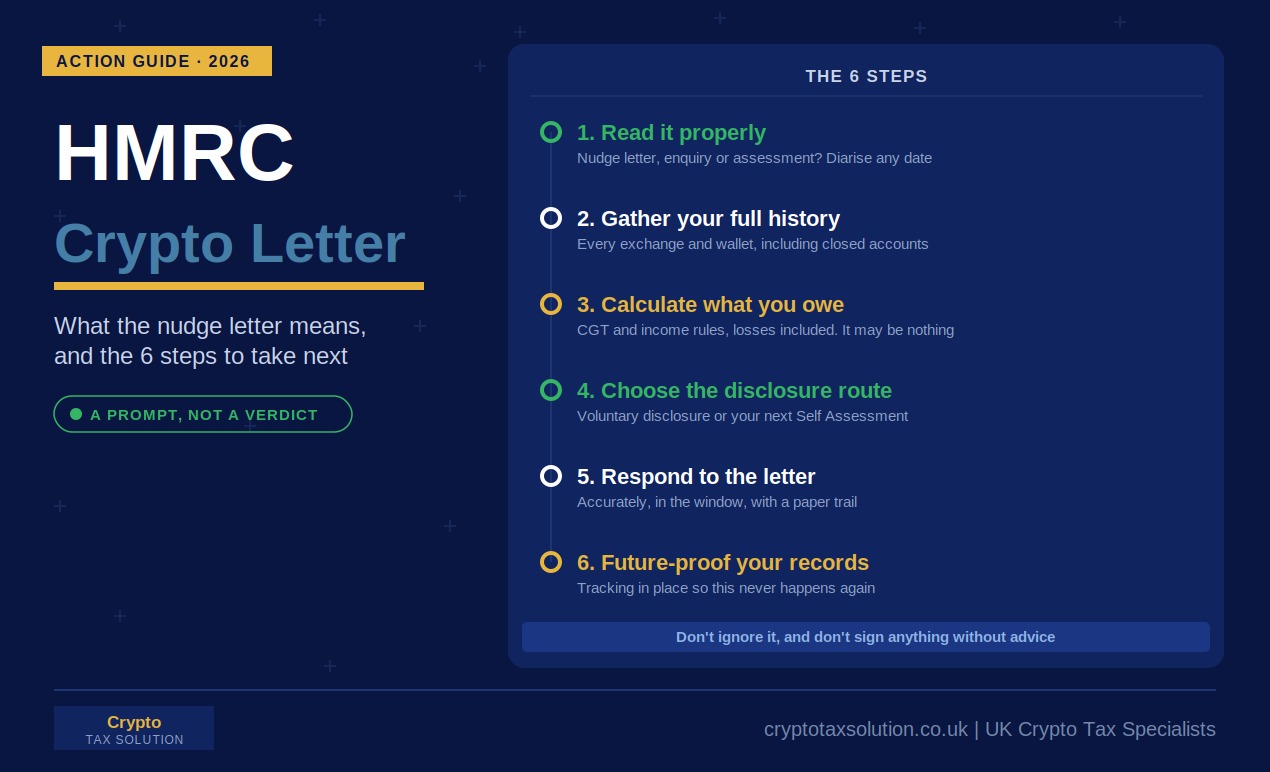
The 6 Steps to Take After an HMRC Crypto Letter
Step 1: Read the letter carefully and diarise any date
Identify what kind of HMRC crypto letter it is, what HMRC says it holds, and whether a response date is given. Nudge letters commonly suggest responding within a set number of days. Even where no statutory deadline exists, a prompt, organised response sets the tone.
Step 2: Gather your complete transaction history
Export records from every exchange and wallet you’ve ever used, including closed accounts and platforms that no longer operate. Gaps in history are the number one cause of wrong calculations, and HMRC’s data may include platforms you’ve forgotten about. This is also the moment to locate bank statements showing transfers to and from exchanges.
Step 3: Calculate what you actually owe, if anything
Apply the rules properly: income treatment for staking, mining and airdrops, Capital Gains Tax for disposals, using HMRC’s matching rules (same day, then 30 days, then the Section 104 pool), all valued in pounds at the time of each transaction. Include your losses, because registered losses offset gains and change the answer. Many recipients of an HMRC crypto letter discover they owe far less than they feared, and some owe nothing at all.
Step 4: Choose the right route to put things right
If tax is owed for earlier years, a voluntary disclosure through HMRC’s digital disclosure processes is normally the way to correct the position, covering the tax, interest, and a penalty calculated on your behaviour. The official starting point is HMRC’s cryptoassets disclosure guidance on GOV.UK. If the current year is affected, your next Self Assessment return handles it. Which route, and how the disclosure is framed, genuinely affects the penalty outcome, which is where specialist input earns its keep.
Step 5: Respond to the letter
Reply to the HMRC crypto letter within the suggested window, stating accurately what you’ve done: that you’ve reviewed your position and a disclosure is underway, or that your review shows nothing is owed and why. Keep a copy of everything. An organised paper trail is quietly powerful if questions ever follow.
Step 6: Get MTD-proof for the future
Once the past is settled, set up record keeping so this never happens again: transaction tracking in place, gains calculated as you go, and disposals reported on time. The reporting environment only tightens from here, so the investors who thrive are the ones whose records are always ready.
Penalties: What’s Actually at Stake
Penalties for unpaid tax are behaviour-based, calculated as a percentage of the tax owed, and the ranges tell you everything about why acting early matters:
- Reasonable care taken: typically no penalty, just the tax and interest
- Careless errors: broadly 0% to 30% of the tax
- Deliberate errors: broadly 20% to 70%
- Deliberate and concealed: up to 100%, and more where offshore matters are involved
Within each band, penalties are reduced for the quality of your disclosure, and unprompted disclosures attract lower penalties than prompted ones. That last point is exactly why the HMRC crypto letter changes things: once it arrives, any disclosure is treated as prompted. It’s still far better to disclose after a letter than to wait for an enquiry, but it’s better again to act before a letter ever comes, which is worth passing on to any crypto-holding friends who haven’t received one yet.
How Far Back Can HMRC Go?
A question almost everyone asks after an HMRC crypto letter arrives: how many years are actually in play? The answer depends on behaviour, and the pattern mirrors the penalty bands:
- Around 4 years where you took reasonable care but an error still occurred
- Around 6 years where the error was careless
- Up to 20 years where the failure was deliberate, or where you never notified HMRC that you needed to file at all
Two practical points follow. First, “I traded years ago, so it’s ancient history” is rarely true; if returns were never filed when they should have been, the long time limits can apply, and the exchange data HMRC now receives makes old activity discoverable. Second, the behaviour assessment is exactly where a well-managed disclosure matters. Presenting the same facts as careless rather than deliberate, where that’s the honest reading, changes both the years assessed and the penalty percentage, which can transform the final bill. This is one of the strongest arguments for not handling an HMRC crypto letter alone if your history spans multiple years.
It’s also why speed matters in the other direction: interest runs on unpaid tax from the original due dates until payment, so every year of delay quietly adds to the total, on top of whatever penalty percentage eventually applies. The cheapest version of any disclosure, in interest, in penalties, and in sleep lost, is always the one made now rather than next year.
What If You Genuinely Owe Nothing?
Plenty of recipients don’t owe a penny: their gains sat within the annual exempt amount, their losses covered their gains, or they only ever bought and held, which is not a taxable event. If that’s you, the HMRC crypto letter still deserves a response. Do the review properly, document the workings that show no tax is due, and reply saying so. A verified “nothing owed” position, with the calculations to prove it, closes the matter cleanly and protects you if the question is ever asked again.
One caution before you self-certify as owing nothing: run the disposal test honestly first. If you ever swapped coins, spent crypto, earned staking rewards, or moved value between platforms in ways you’ve half forgotten, the safe move is to reconstruct the history before declaring the position clean. “I checked and there’s nothing” is a strong answer only when the checking was real.
How Crypto Tax Solution Helps with HMRC Crypto Letters
Responding to an HMRC crypto letter is precisely what we do. We reconstruct your complete transaction history across exchanges, wallets and chains, calculate your true position using HMRC’s matching rules, prepare and manage the disclosure where tax is owed, advise on the certificate of tax position and all correspondence, and put clean, ongoing records in place so future years look after themselves. You get a defensible position and a settled outcome, handled confidentially from start to finish. Explore our crypto tax services or get in touch for a confidential conversation about your letter.
And if you’re reading this without a letter in hand, treat that as the gift it is. Everything above applies with lower penalties and less pressure when the disclosure is unprompted. Reviewing your crypto position now, before an HMRC crypto letter forces the timetable, is the single cheapest version of this entire process.
This article is general guidance based on the rules at the time of writing. Disclosure processes, penalty rules and reporting requirements can change, and your circumstances are unique, so please seek advice tailored to you before responding to any HMRC correspondence.
Frequently Asked Questions
What is an HMRC crypto nudge letter?
It’s a letter HMRC sends to people its data suggests have held or disposed of cryptoassets, prompting them to review their tax position and correct it voluntarily if needed. It is not a formal investigation, but it should never be ignored.
Why did I get an HMRC crypto letter?
Because HMRC holds data linking you to crypto activity, obtained from exchanges through information notices and, since 1 January 2026, through automatic reporting under the Cryptoasset Reporting Framework. The letter means your activity is visible, not necessarily that you owe tax.
Does an HMRC crypto letter mean I’m being investigated?
A nudge letter is not a formal enquiry. However, if you ignore it, or respond inaccurately, a formal enquiry becomes more likely. A letter citing formal enquiry powers or demanding a specific sum is a different document and needs immediate professional advice.
Should I sign the certificate of tax position?
Take professional advice first. There is no legal obligation to complete it, and signing an incorrect declaration can create greater risks than the original issue. Specialists often recommend responding through the proper disclosure route instead.
What happens if I ignore an HMRC crypto letter?
Your details remain in HMRC’s data, and non-response makes a formal enquiry or assessment more likely. Any tax eventually found owing would then carry higher penalties than a prompt, well-managed disclosure would have.
What penalties apply to undeclared crypto gains?
Penalties are a percentage of the unpaid tax and depend on behaviour: broadly up to 30% for careless errors, 20% to 70% for deliberate errors, and up to 100% or more where concealment or offshore factors are involved. Good quality, early disclosure reduces the penalty within each band.
What if I never converted my crypto to pounds?
You may still owe tax. Swapping one cryptoasset for another, spending crypto, and gifting it to anyone other than a spouse or civil partner are all disposals for Capital Gains Tax, and staking or mining rewards are taxable income when received.
Can Crypto Tax Solution respond to HMRC for me?
Yes. We reconstruct your full transaction history, calculate your true position, manage any disclosure to HMRC, handle the correspondence including the certificate of tax position, and set up compliant records going forward, all confidentially.