
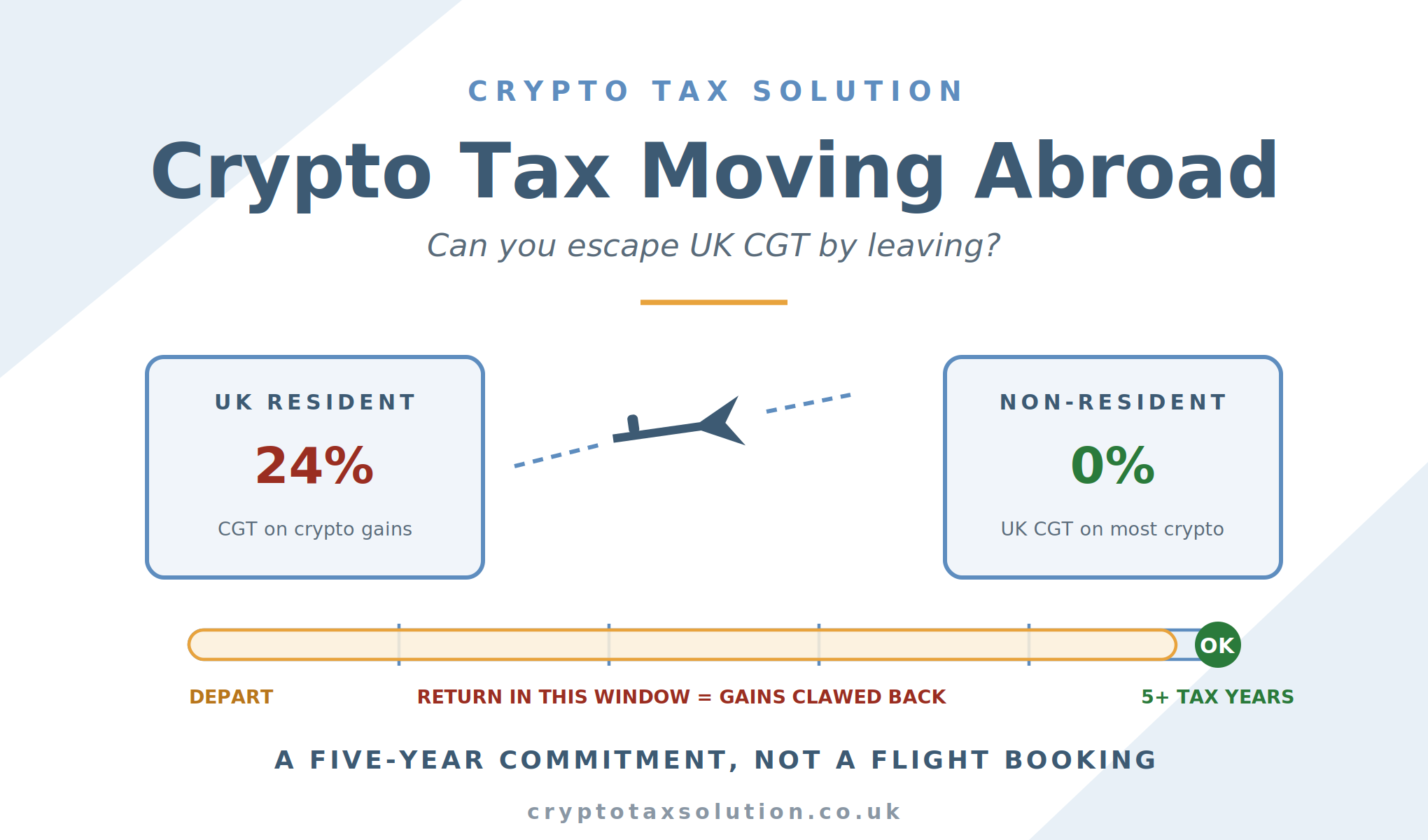
 Crypto tax moving abroad is the plan half of crypto Twitter has sketched on a napkin: move to Dubai, become non-resident, sell the portfolio tax-free, come home rich. The frustrating thing for HMRC, and the useful thing for you, is that the plan genuinely can work. The frustrating thing for you is that the version most people sketch does not, because of a rule most of them have never heard of: temporary non-residence.
This guide explains how crypto tax moving abroad actually works in 2026: when non-residents really do escape UK Capital Gains Tax on crypto, the five-year rule that claws gains back if you return too soon, the residence test that is harder to pass than booking a one-way flight, and how CARF reporting means HMRC sees your disposals wherever you make them.
The true half: non-residents do not pay UK CGT on crypto
Start with the part of crypto tax moving abroad the napkin plan gets right. If you are genuinely non-UK resident for tax purposes, you are outside the scope of UK Capital Gains Tax on most assets, including cryptoassets. The main exceptions are UK land and property (and interests in property-rich companies), which stay taxable regardless of where you live. Bitcoin is not a buy-to-let: sell it as a genuine non-resident and, as far as the UK is concerned, there is normally no CGT.
So the core of crypto tax moving abroad is real, and the crypto tax moving abroad question becomes practical rather than theoretical. Whether crypto tax moving abroad works for you depends on three questions: can you actually become non-resident, can you stay away long enough, and what does your destination country charge? Each one has teeth.
The five-year trap: temporary non-residence
The rule that sinks most crypto tax moving abroad plans is the temporary non-residence rule in the capital gains legislation. In outline:
- If you were solely UK resident in at least four of the seven tax years before you left, the rule applies to you. Almost every long-term UK crypto holder passes through this gateway.
- If you dispose of assets you already owned before departure while you are non-resident, those gains are not forgotten. They are parked.
- If you return to UK residence within five years, the parked gains crystallise and are taxed in the tax year of your return, as if you had never left.
The five years means more than five complete tax years of non-residence, measured from when sole UK residence ceases (the split-year departure date where split-year treatment applies). Come back after four years and eleven months and every crypto gain you realised abroad lands in one UK tax year, stacked together with no spreading relief. Several years of disposals taxed in a single year can push more of the total into the 24% band than if you had simply stayed and sold gradually.
Two details make the rule sharper than most crypto tax moving abroad guides admit:
- It catches pre-departure assets specifically. Coins you bought while UK resident carry their history with you. This is precisely the crypto tax moving abroad scenario the rule was written for: the whole point of the move is usually to sell a portfolio built up over years of UK residence.
- Assets acquired after you leave are generally outside it. Buy new coins as a non-resident and sell them before returning, and the temporary non-residence rule does not normally touch those gains. The rule targets the wealth you took with you, not the wealth you built abroad.
Becoming non-resident is harder than leaving
The second failure point in every crypto tax moving abroad plan is residence itself. UK tax residence is decided by the Statutory Residence Test, and it does not care where your plane landed. In outline for a leaver:
- Automatic non-residence requires very few UK days: fewer than 16 days if you were UK resident in all three prior years, fewer than 46 in some cases, or full-time work overseas (averaging 35+ hours a week) with fewer than 91 UK days.
- Otherwise the sufficient ties test applies: the more connections you keep (a home available in the UK, spouse or minor children here, substantive UK work, 90+ days in either of the previous two years), the fewer days you can spend in the UK before you are resident again.
- Split-year treatment can divide your departure year into a UK part and an overseas part, but only in defined circumstances, and disposals in the UK part are fully taxable.
The classic crypto tax moving abroad failure: keeping the family home available, flying back constantly for family and business, and drifting over the day-count without noticing. If the SRT makes you UK resident for a year you assumed you were away, the crypto tax moving abroad plan collapses: every disposal in that year is simply taxable, and the five-year clock may restart. Anyone serious about crypto tax moving abroad needs a day-count log and a ties review before the first disposal, not after an HMRC letter.
The destination side: where you land matters
The other half of crypto tax moving abroad is the destination: escaping UK CGT only helps if the country you move to does not tax the same gains. The landscape in 2026:
- Genuinely low or zero CGT jurisdictions (the UAE being the famous example) remain the destination of choice for large disposals, though substance requirements, visa conditions and living costs are real.
- Popular European destinations vary sharply. Some tax crypto gains as ordinary income, some exempt long-held coins, and several have trimmed their once-generous regimes. The rules change frequently enough that last year’s blog posts are unreliable.
- Double tax treaties decide which country taxes what when both claim you. Treaty residence tie-breakers do not always land where people assume.
The crypto tax moving abroad point is not that any one destination is best. It is that crypto tax moving abroad is a two-country problem, and solving only the UK half can simply move the tax bill rather than remove it.
CARF: HMRC sees the disposals anyway
The quiet assumption inside many crypto tax moving abroad plans is that once you are abroad, HMRC loses sight of you. From 1 January 2026 that assumption is dead. Under the Crypto-Asset Reporting Framework, crypto service providers collect and report user transaction data, and participating jurisdictions exchange it automatically. Our full CARF guide covers the mechanics.
For leavers this cuts two ways. HMRC can see large disposals made shortly after departure, which is exactly the pattern the temporary non-residence rule exists to catch, and it can match them to your return date years later. And if your plan involved simply not mentioning pre-departure gains, expect the conversation to start with a nudge letter rather than a blank slate. Crypto tax moving abroad now only works as a compliance strategy, done in the open, with the residence position documented. It no longer works as a disappearing act.
Doing it properly: the sequence that works
For someone genuinely committing to crypto tax moving abroad, the workable order of operations looks like this:
- Plan the crypto tax moving abroad departure date against the tax year. Residence and split-year outcomes differ significantly depending on when in the year you leave.
- Establish non-residence first, dispose second. Selling in the UK part of a split year, or before non-residence is secure, wastes the entire exercise.
- Commit to the five complete tax years, or price in the clawback. If there is a realistic chance you return early, model the tax year of return now: all parked gains, one year, current rates.
- Check the destination’s rules and the treaty before assuming the gain lands tax-free anywhere.
- Document everything: day counts, ties, accommodation, the disposal dates and sterling values. The burden of proving non-residence sits with you.
- Keep UK filing obligations alive where they exist, including for any UK property and the year-of-departure return.
Frequently Asked Questions
Do I pay UK tax on crypto if I move abroad?
Not on disposals made while genuinely non-UK resident, unless the temporary non-residence rule applies. If you return to the UK within five complete tax years, gains on crypto you owned before departure are taxed in the year you return. UK land and property remain taxable throughout.
How long do I need to stay out of the UK to avoid CGT on crypto?
More than five complete tax years of non-residence, measured from when your sole UK residence ceases. Return even slightly early and pre-departure gains realised abroad crystallise in your year of return, stacked into a single tax year with no spreading relief.
Can I just sell my crypto from Dubai tax-free?
Only if you have genuinely become non-UK resident under the Statutory Residence Test before selling, and you then stay non-resident for more than five complete tax years, and the coins situation on the UAE side is what you think it is. Miss any leg and the plan fails, usually expensively.
What if I buy crypto after leaving the UK?
Assets acquired after you become non-resident and sold before you return are generally outside the temporary non-residence rule. The clawback targets assets you owned before departure. This distinction is one of the few genuinely useful planning levers for shorter periods abroad.
Will HMRC know about crypto I sell while abroad?
Increasingly, yes. CARF reporting from January 2026 means crypto service providers report transaction data and jurisdictions exchange it automatically. Large post-departure disposals followed by a return within five years form exactly the pattern HMRC is equipped to spot.
Get the crypto tax moving abroad plan checked before you book the flight
Crypto tax moving abroad sits at the junction of the Statutory Residence Test, the temporary non-residence rules, treaty law and the destination country’s own regime, and the cost of getting one component wrong is measured in years of gains taxed in a single return. The plan can work. Crypto tax moving abroad works for people who treat it as a five-year commitment with paperwork, not a flight booking with vibes.
At Crypto Tax Solution we review residence positions, model the clawback risk against your intended timeline, and coordinate the UK side of a relocation with the disposal plan. Get in touch before you leave, because the options narrow sharply after you have. For HMRC’s technical guidance on temporary non-residence, see the Capital Gains Manual.