
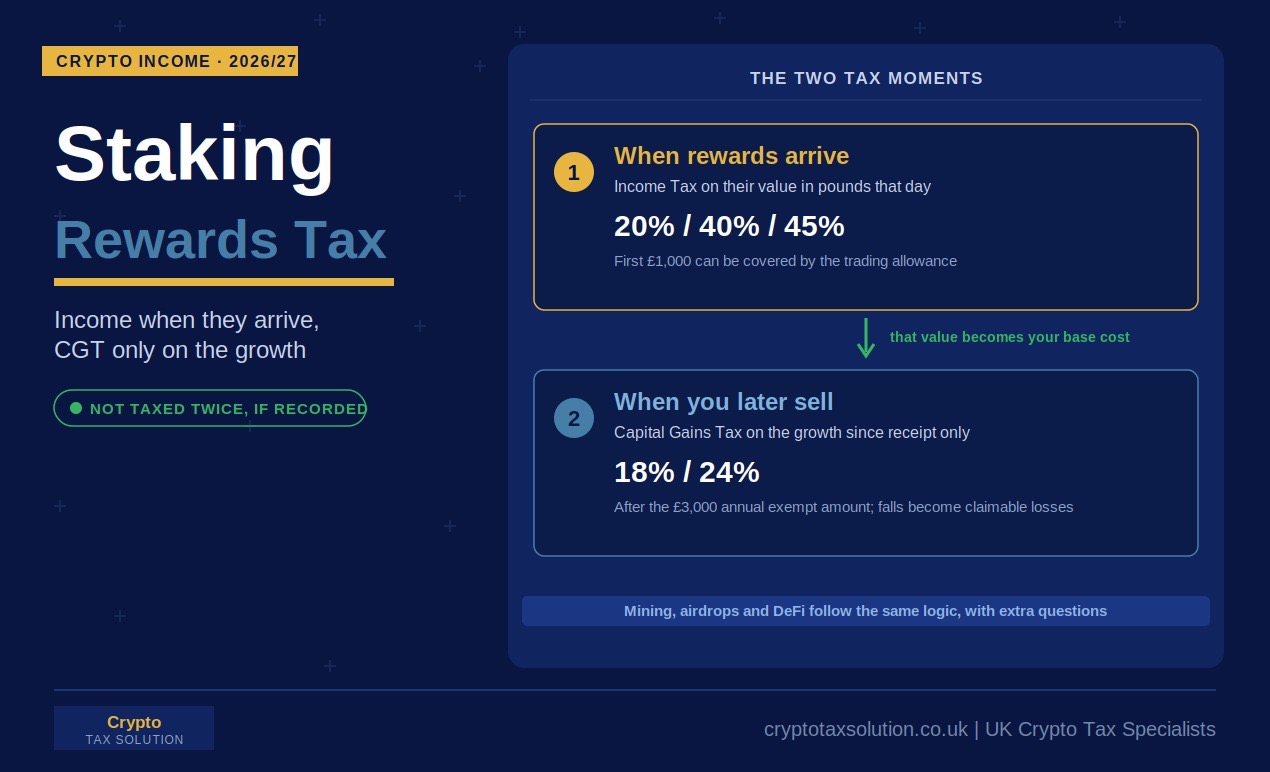
 Staking has quietly become the way millions of people earn from crypto without trading it, and staking rewards are exactly where UK tax gets misunderstood most. Some investors believe rewards are tax free until sold. Others have heard the opposite rumour, that HMRC taxes them twice, and conclude the system is out to get them. The truth sits in between, it’s perfectly logical once laid out, and getting it wrong in either direction is expensive: miss the income side and you’ve underdeclared, miss the base cost rules and you’ll overpay on the way out.
At Crypto Tax Solution, staking rewards questions now arrive as often as questions about selling, and the same confusions repeat. So here’s the complete UK picture for 2026/27: when rewards are income, when the £1,000 allowance saves you entirely, what happens when you later sell, and how the same logic extends to mining, airdrops and DeFi.
Are Staking Rewards Taxable in the UK?
Yes. For most individual investors, staking rewards are taxable income at the moment you receive them, valued in pounds at their market value on the date of receipt. HMRC’s position, set out in its guidance on tax when you receive cryptoassets, is that rewards from staking are generally miscellaneous income for a private investor, taxed at your normal Income Tax rates of 20%, 40% or 45% depending on your band. Only in rare cases, where the activity is organised enough to amount to a financial trade, does it become trading income instead, and for the typical person staking through an exchange or wallet, it isn’t.
The practical consequence: every reward needs a date, a quantity and a pound value at receipt. Rewards that drip in daily make this tedious by hand and trivial with software, which is one of several reasons records decide everything in this corner of crypto tax. And note what “receipt” means in substance: the charge looks at when you obtain the benefit of the rewards, so locked rewards you cannot access yet raise genuine timing questions that are worth taking advice on rather than guessing, particularly where large sums vest at once.
The Two Tax Moments: Why “Taxed Twice” Is Half True
Here’s the structure that unlocks the whole topic. Staking rewards meet tax at two separate moments, but on two separate amounts:
| Moment | What’s taxed | Which tax |
|---|---|---|
| 1. When the reward arrives | Its market value in pounds on that day | Income Tax (20% / 40% / 45%) |
| 2. When you later dispose of it | Only the growth since receipt | Capital Gains Tax (18% / 24%) |
The value taxed as income becomes your base cost for Capital Gains Tax. So nothing is taxed twice; the value at receipt is taxed once as income, and only the gain on top of it is taxed later. If the token falls after receipt, the disposal produces a capital loss, which is claimable against other gains, and our crypto losses guide covers exactly how to protect it. The investors who genuinely get taxed twice are the ones who don’t record the value at receipt, declare no income, then years later can’t evidence a base cost. Good records are literally what prevents double taxation.
Staking Rewards Tax in Numbers: A Worked Example
Meet an investor who stakes ETH through her exchange during 2026/27:
- Across the year she receives rewards totalling 2 ETH, valued at £3,000 in pounds across the various receipt dates
- She has no other miscellaneous or trading income, so the £1,000 allowance (next section) covers the first £1,000, leaving £2,000 taxable as income. As a higher rate taxpayer she pays 40%, which is £800
- Two years later she sells both ETH for £5,000. Her base cost is the £3,000 already taxed as income, so the gain is £2,000, which sits within her £3,000 annual exempt amount. Capital Gains Tax: nil
Total tax on £5,000 of eventual value: £800, with the income side settled through Self Assessment for the year the staking rewards arrived, not the year she sold. That timing surprises people: you can owe tax on rewards you haven’t sold and have no cash from, which is worth planning for in a year of large rewards.
The £1,000 Allowance: When Staking Rewards Are Effectively Tax Free
The trading and miscellaneous income allowance exempts the first £1,000 of this kind of income in a tax year. If your total staking rewards (plus any other miscellaneous or casual trading income sharing the allowance) stay under £1,000 for the year, there’s usually nothing to pay and, for many people in that position, nothing to report on the income side at all. Above £1,000, you choose between deducting the flat allowance or your actual allowable expenses, whichever is better, and only the remainder is taxed.
Two cautions stop this being a loophole. The allowance is shared across all income of this type, so £800 of staking rewards plus £500 of side hustle sales already exceeds it. And it does nothing for the Capital Gains Tax side: the disposal rules apply from the first pound regardless, so even small-scale stakers need receipt values recorded for the base cost.
Mining: The Same Logic, One Extra Question
Mining income follows the same two-moment structure as staking rewards: pound value at receipt is income, later growth is a capital gain. The extra question is whether your mining amounts to a hobby or a trade, judged on the badges of trade: scale, organisation, commerciality, intention. A laptop mining in the spare room is miscellaneous income with the £1,000 allowance available; racks of dedicated rigs with business electricity contracts start to look like a trade, which changes the rules, allows proper expense deductions, and brings National Insurance into play. Most individuals sit comfortably on the hobby side, but the boundary is factual, not chosen, and HMRC decides it on evidence.
Airdrops: It Depends Why You Got Them
Airdrops split into two cases. Tokens received in return for doing something (a service, a promotion, completing tasks, or in expectation of them) are income at market value on receipt, exactly like staking rewards. Tokens that simply appear, with nothing done in return and not as part of a trade, are generally not income when they arrive. Either way, the tokens enter your capital gains world from receipt: dispose of them later and the normal rules apply, with a base cost equal to whatever value was taxed as income, or their value on receipt where the airdrop wasn’t income. Record the circumstances at the time, because reconstructing why an airdrop landed in your wallet three years ago is nobody’s idea of fun.
A related case worth a sentence: being paid in crypto for actual work, by an employer or a client, isn’t an airdrop or staking at all. That’s employment or self-employment income under the normal rules, valued in pounds when received, with PAYE potentially in play for employees. The wrapper is crypto; the tax is ordinary earnings.
DeFi Lending and Liquidity Pools: The Honest Section
DeFi returns, from lending platforms, liquidity pools and yield products, are where certainty runs out, and it would be dishonest to pretend otherwise. The return you earn can be taxed as income or as capital depending on how the arrangement actually works: whether the return is known in advance, whether it’s paid in the same token, and crucially whether depositing your tokens into the protocol transferred ownership of them, which can itself be a disposal of the tokens you deposited, triggering Capital Gains Tax before any reward arrives. HMRC’s guidance in this area is detailed, still evolving, and turns on the mechanics of each protocol.
The practical advice: don’t guess by analogy. Two platforms that look identical from the app can be structured differently underneath, with different tax results. Keep complete records of what you deposited, when, what you received back and what the protocol’s terms say, and take advice before assuming a DeFi position is “just like staking rewards”, because sometimes it is and sometimes it’s a disposal you didn’t know you’d made.
How to Report Staking Rewards to HMRC
The mechanics are more straightforward than people fear, once the numbers exist:
- Register if you need to. If your staking rewards push you over the reporting thresholds and you’re not already in Self Assessment, you need to register with HMRC, and registration has its own deadline in the autumn after the tax year ends. Don’t leave this to filing week.
- The income side goes on your Self Assessment return as miscellaneous income (or trading income in the rare trade cases), using your pound valuations at receipt, less the £1,000 allowance where you’re using it.
- The capital side appears in the capital gains pages in whichever year you dispose of tokens, with the receipt values as base costs and the usual matching rules applied.
- The deadline is the normal Self Assessment timetable: online filing and payment by 31 January after the end of the tax year, so 2026/27 staking rewards are reported and paid by 31 January 2028.
One planning note worth flagging: because the income charge arrives with no cash attached, a strong staking year can produce a January bill with nothing liquid set aside for it. The habit that prevents the scramble is simple: when rewards land, note their pound value and mentally ring-fence your marginal rate’s worth of them. If the tokens later fall, you sell fewer to cover the bill than you feared; if they rise, the surplus is yours. Either way January stops being a surprise.
Records and Visibility: HMRC Already Sees the Rewards
Since 1 January 2026, the Cryptoasset Reporting Framework has crypto platforms collecting customer transaction data for automatic reporting to tax authorities, and reward payments are part of the picture HMRC receives. Undeclared staking rewards are precisely the kind of mismatch, visible activity next to a silent tax return, that generates the nudge letters we’ve written about separately. The defensive position is simple: a record of every reward with date, quantity and pound value, income declared where it exceeds the allowance, and base costs tracked for the eventual disposal. Software handles the mechanics; the discipline is just doing it from the start rather than reconstructing years later.
4 Mistakes People Make with Staking Rewards
- Believing rewards are only taxed when sold. The income charge lands at receipt, whether or not you ever sell. Waiting for the sale means filing late and explaining why.
- Forgetting the base cost on the way out. Rewards taxed as income at £3,000 and later sold for £5,000 produce a £2,000 gain, not £5,000. Declaring the full proceeds as gain is the self-inflicted double tax.
- Letting small rewards pile into a big surprise. Daily drips feel negligible, but a year of them in a bull market can clear the £1,000 allowance and land a four-figure income charge payable before any tokens were sold. Check the running total mid-year, not at filing time.
- Treating every DeFi yield as staking. As above, some arrangements are income, some are capital, and some trigger a disposal on entry. The label on the app decides nothing, and the tax outcome can differ wildly between two products both marketed as staking rewards.
How Crypto Tax Solution Helps
We untangle exactly this. We reconstruct your reward history across exchanges, wallets and protocols, value every receipt in pounds, apply the allowance and the income rules correctly, track base costs so your eventual disposals are taxed on the true gain and nothing more, and handle the Self Assessment reporting end to end. Where DeFi positions need analysis, we work from how the protocol actually operates rather than its marketing. The full framework around all of it, rates, disposals and deadlines, is in our UK crypto tax guide, and for a confidential review of your staking rewards position, get in touch.
This article is general guidance based on the rules and HMRC guidance at the time of writing. The treatment of staking, mining, airdrops and DeFi can change and is often fact specific, so please seek advice tailored to your circumstances before relying on it.
Frequently Asked Questions
Are staking rewards taxable in the UK?
Yes. For most individual investors, staking rewards are miscellaneous income, taxed at your Income Tax rate (20%, 40% or 45%) on their market value in pounds when received. The first £1,000 may be covered by the trading and miscellaneous income allowance.
Are staking rewards taxed twice?
No, though it looks that way at first. The value at receipt is taxed once as income, and that value becomes your base cost. When you later sell, Capital Gains Tax applies only to the growth since receipt, so each pound of value is taxed once.
What if I earn less than £1,000 in staking rewards?
If your total staking rewards plus any other miscellaneous or casual trading income stay under £1,000 in the tax year, the allowance usually means no Income Tax and, for many people, nothing to report on the income side. You still need receipt values recorded, because Capital Gains Tax applies when you eventually dispose of the tokens.
When do I pay the tax on staking rewards?
The income is taxed for the year the rewards were received, through Self Assessment, even if you haven’t sold the tokens and have no cash from them. The Capital Gains Tax side only arises later, when you dispose of the tokens.
What happens if my staking rewards fall in value after I receive them?
The income charge is based on the value at receipt and doesn’t retrospectively change. Selling below that value produces a capital loss, which you can claim and set against other gains, so record and report it rather than letting it lapse.
Is crypto mining taxed the same as staking?
Broadly yes for hobby miners: pound value at receipt is miscellaneous income, later growth is a capital gain, and the £1,000 allowance can apply. Mining at commercial scale can amount to a trade, which changes the rules and brings National Insurance into the picture.
Are airdrops taxable in the UK?
Airdrops received in return for doing something, or in expectation of a service, are income at market value on receipt. Airdrops received with nothing done in return are generally not income, but all airdropped tokens fall within Capital Gains Tax when later disposed of.
How is DeFi lending or liquidity pool income taxed?
It depends on the arrangement’s mechanics: returns can be income or capital, and depositing tokens into some protocols is itself a disposal for Capital Gains Tax. The treatment is fact specific and HMRC’s guidance is detailed, so take advice rather than assuming it works like staking rewards.