
HMRC crypto enquiry letters are becoming more common
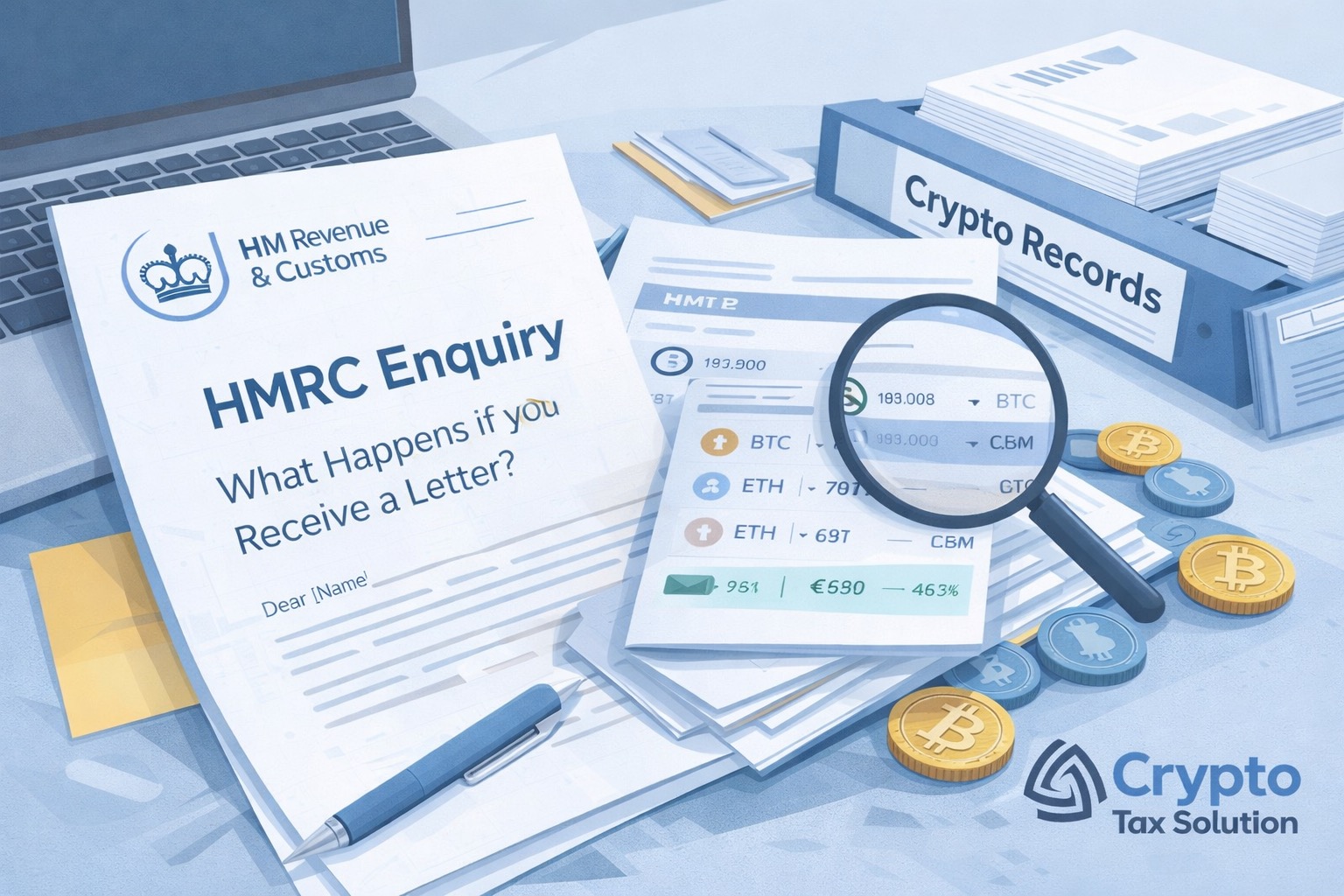 For many investors, the first real moment of concern isn’t during trading.
It’s when a brown envelope arrives.
An HMRC crypto enquiry usually means HMRC believes there may be undeclared gains, incomplete disclosures, or inconsistencies between reported figures and third-party data.
That does not automatically mean wrongdoing.
But it does mean HMRC wants answers.
Understanding how an enquiry works can help you respond calmly and correctly.
Why Would HMRC Open a Crypto Enquiry?
An enquiry can be triggered by:
-
Exchange data shared with HMRC
-
International reporting frameworks
-
Discrepancies in self-assessment returns
-
Large unexplained capital gains
-
Information received from overseas authorities
HMRC has made it clear that digital asset activity falls within existing tax rules.
You can review their published position in the official cryptoassets manual
As crypto reporting becomes more data-driven, the likelihood of an HMRC crypto enquiry increases where records don’t align.
What Does the Letter Usually Ask For?
Most HMRC crypto enquiry letters request:
-
A breakdown of wallet addresses
-
Exchange account histories
-
Details of disposals and gains calculations
-
Evidence supporting acquisition costs
-
Clarification of staking or income receipts
The scope can vary.
Some enquiries are narrow and focused on a single tax year.
Others review multiple years of activity.
The Timeline of an HMRC Crypto Enquiry
An HMRC crypto enquiry generally follows a structured process:
-
Initial notification letter
-
Information request
-
Review of submitted data
-
Follow-up questions
-
Conclusion letter or assessment
The tone is usually procedural rather than accusatory.
However, deadlines are strict.
Ignoring an enquiry can escalate matters unnecessarily.
Potential Outcomes
An HMRC crypto enquiry can end in several ways:
-
No further action
-
Amendment of a tax return
-
Additional tax due
-
Interest charges
-
Penalties (if inaccuracies are found)
Penalties often depend on behaviour classification, such as careless or deliberate errors.
You can read HMRC’s general guidance on penalties here.
The outcome of an enquiry is heavily influenced by the quality of your records and your cooperation.
What You Should Not Do
When faced with an HMRC crypto enquiry, avoid:
-
Guessing missing figures
-
Sending incomplete spreadsheets
-
Ignoring deadlines
-
Relying solely on exchange profit summaries
-
Deleting historical wallet data
Once HMRC opens an enquiry, accuracy becomes critical.
Why Preparation Matters
Many enquiries stem from poor documentation rather than intentional non-compliance.
Clear transaction histories, reconciled wallets, and defensible calculations dramatically improve how an HMRC crypto enquiry concludes.
Being proactive before HMRC contacts you is always easier than reconstructing years of activity under time pressure.
How Far Back Can HMRC Look During a Crypto Enquiry?
One of the most common concerns during an HMRC crypto enquiry is how many years HMRC can review.
The answer depends on the circumstances.
In standard cases, HMRC can usually look back four tax years. However, if they believe there has been careless behaviour, this can extend to six years. In cases involving deliberate errors, HMRC can potentially review up to twenty years of records.
This is why an HMRC crypto enquiry should never be treated casually.
Crypto transactions are timestamped, recorded on exchanges, and often traceable on public blockchains. Even if you no longer use a particular platform, historical data may still exist.
If you have:
-
Closed exchange accounts
-
Lost access to older wallets
-
Traded on overseas platforms
-
Participated in early ICOs or token launches
HMRC may still request supporting evidence during a crypto enquiry.
Another important factor is disclosure. If you realise before or during an HMRC crypto enquiry that earlier returns were incomplete, voluntary correction can reduce potential penalties. HMRC generally distinguishes between taxpayers who cooperate and those who withhold information.
The practical reality is this:
An HMRC crypto enquiry is far easier to resolve when records are organised across multiple years rather than reconstructed at short notice.
If your crypto activity spans several tax years, it is sensible to review earlier filings now rather than waiting for HMRC to ask questions later.
The Bottom Line
Receiving an HMRC crypto enquiry letter can feel alarming.
In reality, it is a structured review process.
Handled correctly, it can be resolved methodically.
Handled poorly, it can become expensive.
If you’ve received an enquiry or suspect your filings may need review, addressing it early protects both your finances and peace of mind.
Enjoyed this? Check out our other blogs HERE.