
Crypto Staking Tax UK: What HMRC Expects You to Report
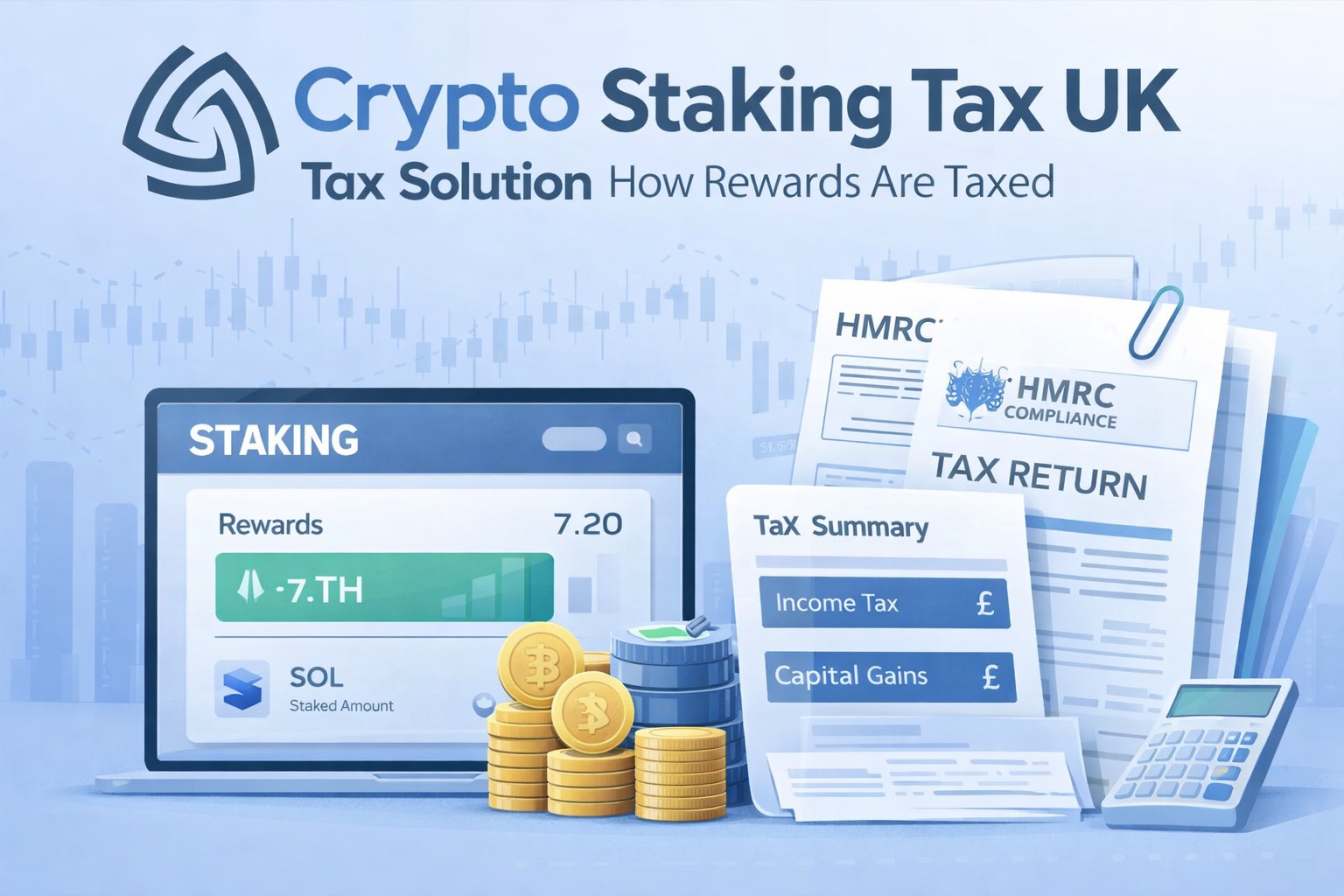
Crypto staking tax UK rules are widely misunderstood.
Many investors assume staking rewards are either “not taxable” until sold, or automatically handled by exchanges. Neither assumption is safe.
If you stake Ethereum, Cardano, Solana or any other token, crypto staking tax UK treatment depends on how and when you receive rewards, and what you do with them afterwards.
Understanding crypto staking tax UK rules properly helps you avoid underreporting income and miscalculating future capital gains.
Is Crypto Staking Taxable in the UK?
In most cases, yes.
HMRC generally treats staking rewards as income at the point you receive them. That means crypto staking tax UK usually falls under Income Tax first, not Capital Gains Tax.
The value to declare is:
The GBP market value of the tokens at the time you receive them.
This creates two layers of tax:
-
Income Tax when rewards are received
-
Capital Gains Tax if you later dispose of those rewards
This is where many crypto staking tax UK mistakes happen.
You can review HMRC’s cryptoasset manual here.
Why Staking Creates a Record-Keeping Problem
Unlike a single trade, staking generates repeated micro-transactions.
Daily.
Weekly.
Sometimes multiple times per day.
For crypto staking tax UK reporting, you need:
-
Date received
-
Token amount
-
GBP value at receipt
-
Platform used
Exchanges rarely present this in a format aligned perfectly with UK tax reporting.
If you restake rewards automatically, the complexity increases. Each reward is income first, then added to your Section 104 pool for future disposals.
Ignoring this is one of the most common crypto staking tax UK errors.
What Happens When You Sell Staking Rewards?
Once staking rewards have been taxed as income, their GBP value at receipt becomes your cost basis.
If you later sell those tokens, crypto staking tax UK rules require you to calculate a capital gain or loss based on:
Sale value – original GBP value at receipt
This second calculation is often overlooked.
Many investors accidentally pay too much tax by:
-
Forgetting income was already declared
-
Miscalculating allowable cost
-
Relying purely on exchange summaries
Are All Staking Activities Treated the Same?
Not necessarily.
The crypto staking tax UK position can vary depending on:
-
Whether activity is considered passive investment
-
Whether it resembles a trade
-
The scale and organisation of activity
In most retail cases, staking is treated as miscellaneous income rather than trading income. However, high-frequency or structured operations may require deeper analysis.
For broader UK Income Tax guidance, see:
How to Stay HMRC Ready
If you are involved in staking, take these steps:
-
Export staking reward histories regularly
-
Convert token values to GBP at the date received
-
Track income separately from capital disposals
-
Maintain consolidated records across platforms
-
Review your Self Assessment before submission
Crypto staking tax UK issues typically arise not from large profits, but from incomplete records.
Another area often overlooked in crypto staking tax UK reporting is platform risk and token volatility. Because staking rewards are taxed based on their GBP value at the time of receipt, a sharp market drop afterwards does not remove the original Income Tax liability.
This creates a scenario where investors owe tax on value that no longer exists. Planning ahead by setting aside a portion of rewards in stable value or GBP can prevent unexpected cashflow pressure when your Self Assessment deadline arrives.
Final Thoughts
Crypto staking tax UK reporting is not just about paying tax when you sell.
It begins the moment rewards hit your wallet.
Each staking reward creates:
-
A potential Income Tax liability
-
A future Capital Gains calculation
-
A record-keeping obligation
If staking forms a significant part of your crypto strategy, reviewing your crypto staking tax UK position properly can prevent future corrections and penalties.
Enjoyed this? Check out our other blogs HERE.